


A low taper fade buzz cut is a short, even clipper cut on top with sides and back that shrink gradually toward the sideburns and neckline. The taper starts low, just around the ears and the nape. That keeps the look clean, soft and easy to wear. You get the speed of a classic buzz cut with the polish of a barber’s fade. It’s one of the few low-maintenance men’s haircuts that still looks sharp in a suit or a hoodie.
Maybe you’re wondering which guard number to ask for. Maybe you worry about your receding hairline, your beard or the shape of your head. This guide covers all of it in plain talk. You’ll learn what the cut is, who it suits, how to order it, and how to keep it fresh between visits. Think of it as a chat with a barber friend who actually has time to explain things.
What is a low taper fade buzz cut?

A low taper fade buzz cut pairs a uniform buzz on top with a taper fade that begins low on the head. Your barber uses a longer clipper guard up top, usually a #2, #3 or #4. Then they shorten the sides and back step by step until the hair nearly disappears at the edges. The change happens only around the ears and neckline taper, so the rest looks like a normal buzz.
People search for it under several names. You’ll hear low taper buzz cut, buzz cut with low taper and low taper fade haircut. They all describe the same idea. A neat buzz up top, a gentle fade around the edges. Barbers recognize every one of those names, so don’t stress about the wording.
Why the starting point matters
The starting point decides how bold the cut looks. A fade that begins low leaves most of the side hair alone. It frames the ears and curves toward the nape. A temple fade or high start, in contrast, exposes much more scalp and shifts the whole mood of the haircut.
A low start also flatters more head shapes. It adds a little structure without cutting the head into two halves. Think of it like a soft picture frame instead of a heavy black border. If you’ve never had a fade, this is the safest door to walk through.
What a taper adds that a plain fade doesn’t
A plain fade can slide all the way to bare skin. A taper fade usually stops short of that. It leaves a thin layer of hair at the hairline, sideburns and back of the neck. That small difference makes the cut look neat but natural, not harsh.
A taper also grows out more gracefully. After three weeks, you still look tidy, since the shortest part isn’t a stark skin line. That’s why many men choose a taper for office jobs, school and daily wear. It forgives lazy schedules.
Low taper fade buzz cut receding hairline

Is a low taper fade buzz cut good for a receding hairline? Yes, and it’s often the best option. When the hair is short and even, a thinning hairline looks like a deliberate style instead of a problem. A long, floppy cut draws attention to gaps. A buzz hides them.
The trick is to pick the right length. Go with a #2 or #3 guard so the top doesn’t show too much scalp. A very short buzz can make a receding hairline more obvious, especially on lighter hair. A slightly longer one blends the transition.
A subtle line-up helps too, but be careful. Ask your barber to keep the front edge soft and follow your natural hairline instead of pushing it forward. A hard, straight line across thinning temples looks fake. A soft shape-up looks honest.
Here’s a quick guide for low taper fade buzz cut for thinning hair:
- Use a #2 or #3 guard. It keeps contrast low between hair and scalp.
- Skip very high fades. Too much exposed skin makes thinning more visible.
- Keep the sides matched to the top. A low taper stays quiet and balanced.
- Add scalp care. A light scalp moisturizer keeps skin healthy and non-shiny.
Many men also notice that a buzz makes their hair density look better overall. Short hair stands up instead of laying flat, so sparse patches become less noticeable. If you’re debating a full shave, try a #3 buzz first. You can always go shorter later.
Low taper fade buzz cut with beard

A low taper fade buzz cut with beard is a classic pairing. The short hair keeps the focus on your face, and the beard adds depth around the jaw. Neither side overwhelms the other. The combination looks tidy, mature and confident.
The secret is a beard-connected fade. Your barber blends the sideburns into the beard so there’s no sudden jump between hair and facial hair. It looks like one smooth gradient from scalp to chin. A mismatch, in contrast, makes the beard look pasted on.
You can pick between a few beard styles:
- Short stubble: pairs nicely with a #2 guard and a soft line-up.
- Medium beard: works well with a low taper fade with beard and a sharper edge-up.
- Full beard: balances best with a #3 or #4 top, so the head doesn’t look too small.
Don’t forget the neckline. Your beard line should sit about a finger or two above the Adam’s apple. A clean line makes the whole buzz cut with beard feel intentional. Skip that detail, and the beard drifts into the neck.
Some men ask whether the beard should match the buzz length. Not necessarily. A slightly longer beard against a short top creates contrast and strengthens the square jawline. Just keep both sides trimmed on the same schedule, so one doesn’t outgrow the other.
Best low taper fade buzz cut styles

The low taper fade buzz cut isn’t one rigid look. It’s a base you can change in small ways. A few tweaks turn a plain cut into something with personality. Here are the best styles to ask for.
The classic uniform buzz. Same length all over the top, with a clean low taper at the edges. This is the classic buzz cut most people picture. It’s quick, neat and nearly impossible to mess up.
The textured buzz cut. Your barber uses clipper over comb work to leave a bit of uneven length on top. It gives you a textured buzz cut with visible movement. It looks modern and works well if your hair has some wave.
The line-up buzz. This version adds a crisp line-up around the forehead and temples. It’s sharp and high contrast, a great fit for dark hair. It does need frequent touch-ups, though.
The textured crop. A slightly longer top, around #4 to #5 or more, styled forward with a little matte clay. The low taper keeps the sides slim. It’s the bridge between a buzz and a short crop.
The faux hawk buzz. Your barber leaves a little extra length down the center and tapers the sides low. It’s playful but still controlled. This one suits men who want some edge without a bold change.
Low taper fade buzz cut with design. Some men add a small part line or a thin shaved pattern. Keep it subtle at the beginning. Designs fade quickly, and they demand frequent maintenance.
Choosing your buzz length: a clipper guard guide

Your buzz cut hair length comes down to the clipper guard number. The number tells you how much hair stays on your head. Lower numbers mean shorter hair. Here’s a simple reference.
| Guard number | Length | What it looks like |
|---|---|---|
| Guard number #1 | 1/8 inch (3 mm) | Very short, scalp shows clearly |
| Guard number #2 | 1/4 inch (6 mm) | Short and neat, the most popular choice |
| Guard number #3 | 3/8 inch (10 mm) | Soft and balanced, hides thin spots |
| Guard number #4 | 1/2 inch (13 mm) | Fuller buzz with visible texture |
| Guard number #5 | 5/8 inch (16 mm) | Short crop territory |
So, what guard number for a low taper buzz cut works best? For most men, a #2 or #3 is the sweet spot. It looks clean without exposing too much scalp. If you want a bolder look, try a #1. If you want it softer or need to cover thin areas, go with a #4.
Keep in mind that exact lengths vary a little between brands. A #2 guard on one clipper might feel slightly different on another. That’s why a good barber consultation matters. Show your barber the length you like on a photo, and let them adjust.
Hair type also changes how a length looks. Thick, coarse hair at a #2 looks fuller and darker than fine hair at the same setting. If your hair is very fine hair, you may want to go one step longer so it doesn’t look see-through.
Another tip: start longer. You can always cut shorter, but you can’t glue hair back on. Ask for a #3 first, then see how it feels. If you like it, go to #2 on your next visit.
Low taper fade buzz cut for straight, wavy, curly, and coily hair

Your hair texture affects how a low taper fade buzz cut sits. The cut works on every type, but small changes make a big difference. Let’s look at each one.
For straight hair, the buzz lies flat and even, so mistakes show up fast. A good fade is essential. Low taper fade for straight hair looks crisp and uniform. Go with a #2 or #3 to avoid showing too much scalp.
For wavy hair, the cut shows a bit of natural movement even when short. A low taper fade for wavy hair often looks thicker and more textured. Try a #3 or #4 on top, and let the waves peek through.
For curly hair, hair shrinkage matters. A low taper fade for curly hair at a #3 can look shorter once the curls tighten. Barbers often use clipper over comb to keep the top soft and even. A bit of curl cream or light oil adds definition.
For coily hair, the fade has the strongest contrast. A low taper fade for coily hair creates crisp edges against dense texture. Use #2 to #4 depending on how much volume you want. Moisturize regularly, since coily hair dries out quickly.
Here’s a short summary:
- Straight: crisp, clean, needs precise blending.
- Wavy: relaxed, textured, forgiving.
- Curly: soft top, needs moisture and extra length for shrinkage.
- Coily: strongest contrast, needs hydration and sharp edges.
Best low taper fade buzz cut for your face shape

Your face shape helps decide the best length and fade height. A low taper is flexible, so it works on almost everyone. Still, a few adjustments can improve the balance. These are the low taper fade face shapes to know.
Round face: Pick a slightly longer top, around a #3 or #4, and keep the taper low. The extra height elongates the face. A low taper fade buzz cut for round face also looks great with a subtle line-up. Avoid very short sides that widen the look.
Square face: Your jaw already has strong angles. A #2 or #3 buzz with a clean taper highlights them. A low taper fade buzz cut for square face looks bold and masculine without trying.
Oval face: You’ve got the easiest job. Almost any length works. A #2 with a low taper looks sharp, and a #4 looks softer.
Diamond face: Cheekbones are the widest part, so keep the sides tight and the top a bit fuller. A #3 with a low taper balances the forehead and jaw.
Heart-shaped face: The forehead is wide, and the chin is narrow. A slightly longer buzz, like a #3 or #4, softens the top. A beard helps balance the chin.
Oblong face: Avoid too much height. A short #2 or #3 buzz keeps the face from looking longer. A low taper is perfect, since it doesn’t add vertical length.
Not sure of your shape? Pull your hair back, look straight into a mirror and trace your outline with a washable marker. The result is usually obvious in seconds. Then pick the length that matches.
Line-ups and shape-ups: getting the edges right

The edges are what make a buzz cut look expensive. A line-up, also called an edge-up, is a sharp, defined line along the forehead and temples. A shape-up is a softer, more natural version. The difference matters.
A hard line-up creates strong contrast and suits men with dense, healthy hairlines. A soft shape-up works better if your hairline is uneven or receding. Ask for the soft version if you want a relaxed, natural look. Ask for the sharp version for a bolder style.
Check the temple edges and sideburns too. They should match on both sides. Uneven sideburns look sloppy, even if everything else is perfect. Barbers use a detail trimmer and sometimes a razor to finish the line.
The neckline taper deserves attention. A natural taper follows the shape of your neck and fades gently. A squared or blocked line looks heavier and needs more frequent upkeep. For a low-maintenance haircut, go natural.
Be careful with razor finishes if your skin is sensitive. A close razor shave on the hairline can cause razor bumps and ingrown hairs. If that happens, ask your barber to use clippers or a trimmer instead. A slight shadow still looks clean.
How to ask your barber for a low taper fade buzz cut
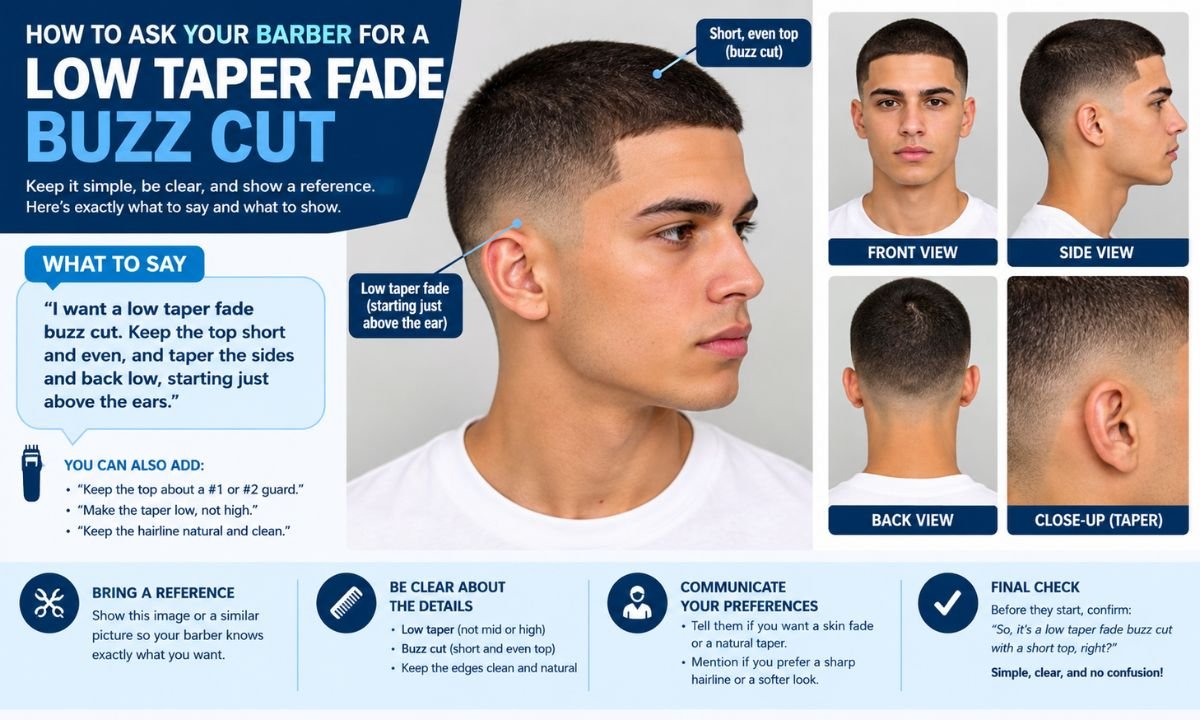
A great haircut starts with clear words. Many bad cuts happen because the instructions were vague. A quick barber consultation fixes that. Here’s how to ask a barber for a low taper buzz cut like a pro.
Tell your barber five things:
- Top length: which guard number you want, such as a #2 or #3.
- Fade type: a low taper fade, not a skin fade, unless you want bare skin.
- Starting point: low, around the ears and the nape.
- Edges: line-up, soft shape-up or no edge work.
- Beard: whether you want a beard-connected fade.
A sentence like this works well: ‘I’d like a number three on top, a low taper fade around the ears and neckline, soft shape-up, and blend into my beard.’ It’s short, clear and complete. Your barber can follow it without guessing.
Bring a reference photo. Pick one that shows a similar hair texture and head shape. Show the side and back, not just the front. Photos help even when you’re confident with words.
Also mention the things you don’t want. Say ‘not too high’ or ‘no hard line on the front.’ Barbers appreciate it, since it prevents mistakes before they happen. And if something doesn’t look right, speak up before the cut ends.
Low taper fade vs mid taper vs skin fade
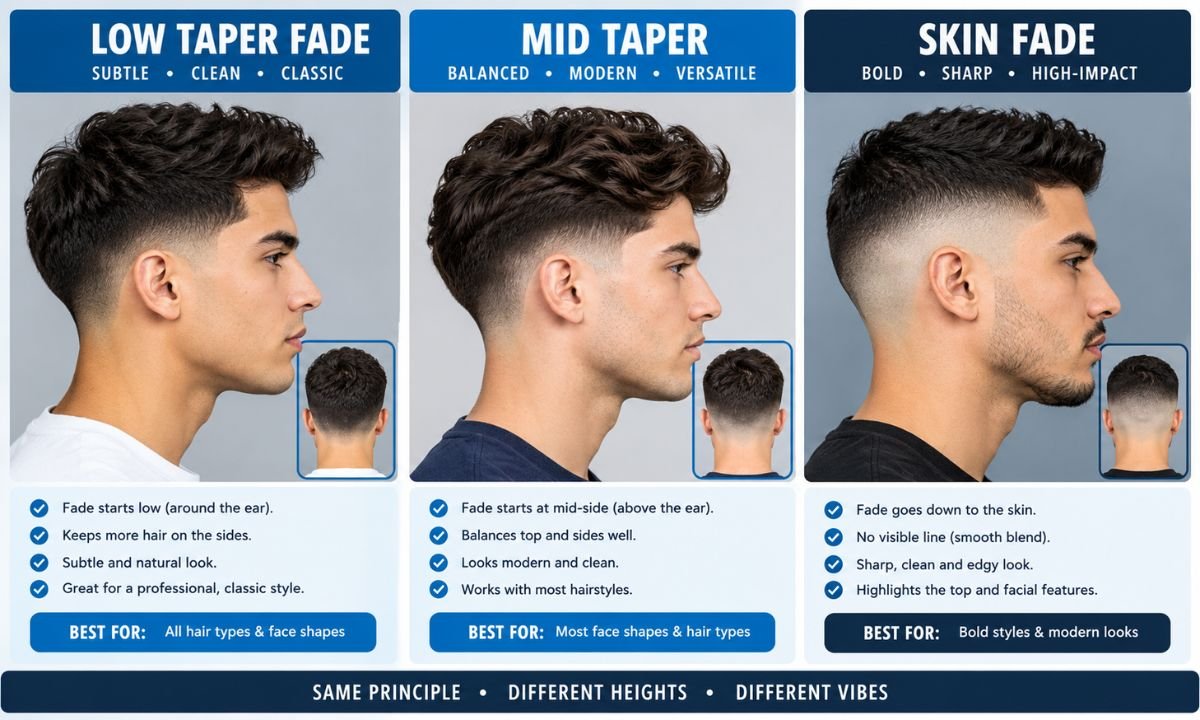
The names get confusing fast. Let’s sort them out. A low taper starts low and affects only the edges. A mid taper fade starts around the temples. A high taper fade goes higher still. The higher the start, the bolder the cut.
What about low taper vs low fade? A taper trims gradually and keeps a bit of hair at the edges. A low fade usually goes shorter and may reach skin. Barbers often use the words loosely, so show a photo to avoid confusion.
And low taper fade vs skin fade? A skin fade goes down to bare skin, so the edge looks sharp and high contrast. A taper is softer and grows out slowly. A low drop fade curves lower behind the ear and sits somewhere in between.
| Cut | Starting point | Look | Upkeep |
|---|---|---|---|
| Low taper fade | Just above the ears and nape | Soft, natural | Low |
| Mid taper fade | Around the temples | Balanced, noticeable | Medium |
| High taper fade | Above the temples | Bold, sharp | High |
| Skin fade | Varies, ends at bare skin | Sharp, high contrast | High |
| Low drop fade | Curves down behind the ear | Stylish, rounded | Medium |
If you want the easiest option, go with the low taper. If you want drama, go with a mid or high taper. If you love sharp contrast, pick a skin fade. Your lifestyle should decide, not just the trend.
Low taper fade buzz cut for professional settings
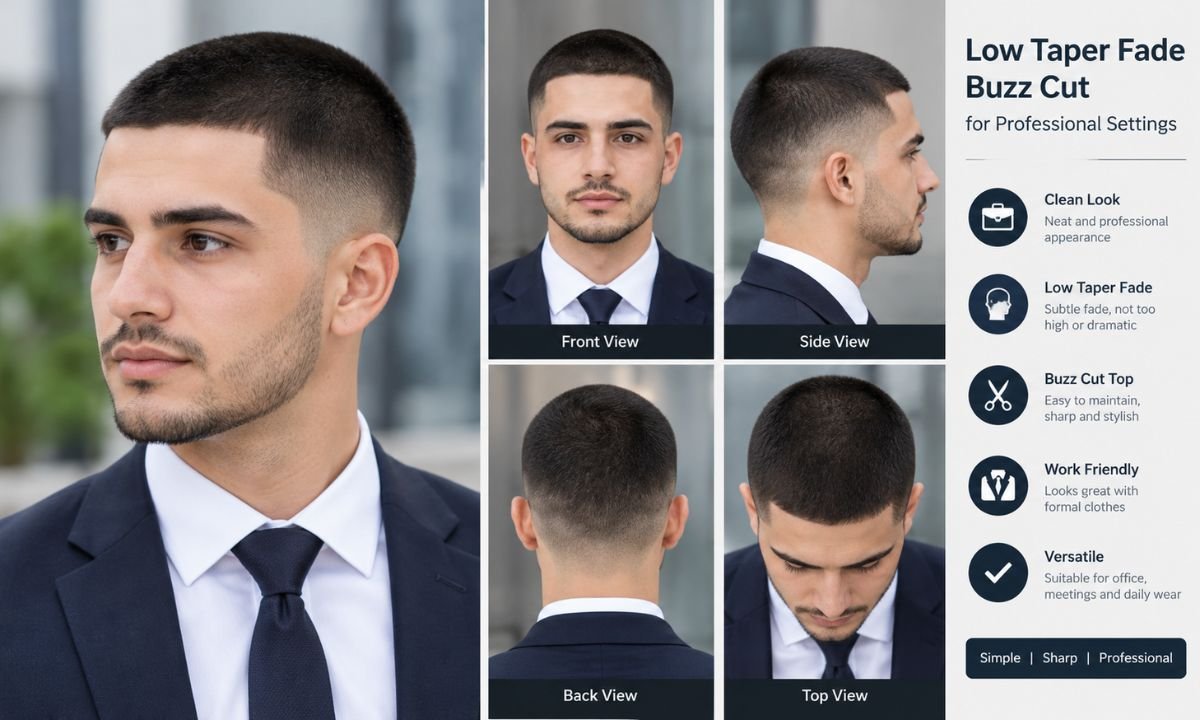
Can you wear a low taper fade buzz cut to work? Absolutely. In fact, it’s one of the safest short styles for a professional environment. It looks clean, controlled and easy. Few managers will object to it.
The key is to keep the contrast low. A #2 or #3 buzz with a soft taper reads as neat, not edgy. Avoid dramatic designs or very high fades if your workplace is conservative. A natural neckline taper works better than a squared edge.
Pair the cut with clean grooming. Trim your sideburns, shape your beard and keep your hairline tidy. A buzz cut leaves no room to hide an untidy edge. Small details matter more when the hair is short.
And if you wear a suit, the cut looks even better. The short sides draw attention to the collar and jaw. That small contrast makes you look sharp without trying.
How to maintain a low taper fade buzz cut
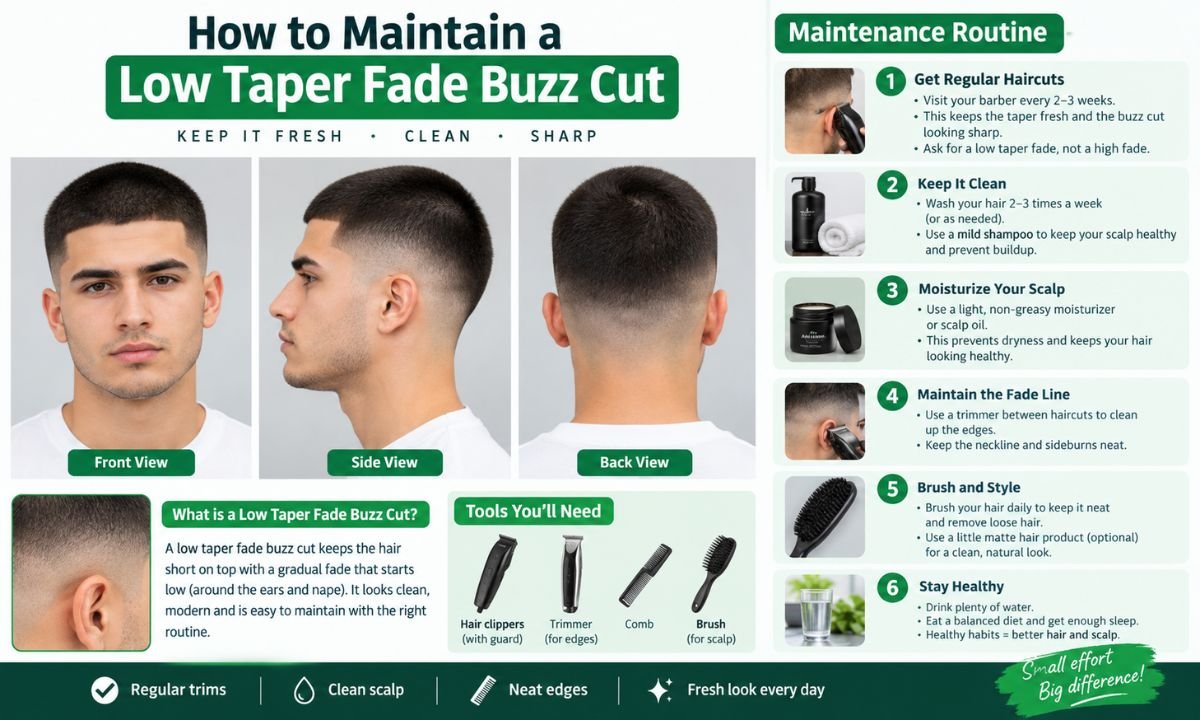
Maintenance is where this cut shines. It’s easy, but it isn’t zero effort. Here’s how to maintain a low taper fade buzz cut so it looks fresh for longer.
How often should you visit the barber? Most men need a touch-up every two to three weeks. The taper blurs first, then the hairline. If you love a crisp line-up, go closer to every two weeks. For a softer look, three or four weeks is fine.
What can you do at home? Not much with the fade itself, but you can keep the edges clean. Use a detail trimmer to tidy the neckline and sideburns only. Avoid touching the taper line. A shaky hand can ruin it quickly.
How to maintain a buzz cut at home? If you own adjustable clippers, keep the top even with the same guard number. Move against the grain slowly, then check in the mirror. Clean the blades before and after use. And don’t try to fade the sides yourself unless you’ve practiced.
Here’s a simple routine:
- Wash with a gentle shampoo two or three times a week.
- Moisturize your scalp with a light scalp moisturizer.
- Protect your scalp from the sun with sunscreen.
- Trim the edges every week or two.
- Book a barber touch-up every two to three weeks.
For styling, very short buzzes don’t need much. A tiny bit of matte clay or light pomade can add texture on a #4 or longer. Skip heavy products. They make short hair look greasy.
Scalp care, razor bumps and ingrown hairs

A fresh buzz exposes your scalp, so it needs a little love. Dry skin, flakes and irritation show up quickly on short hair. Good scalp care keeps the cut looking healthy. It also prevents problems before they start.
Use lukewarm water, not hot. Hot water dries the skin and makes it itch. Pat your scalp dry afterward, don’t rub it. Then apply a light, fragrance-free moisturizer to the shaved areas.
Razor bumps and ingrown hairs are common around the neckline and sideburns. They happen when cut hair curls back into the skin. Curly and coily hair types get them more often. To reduce the risk, ask your barber to use clippers instead of a razor.
If you do get bumps, don’t pick or squeeze them. Wash the area gently, use a warm compress and apply a soothing product. If the bumps are painful, spread or last more than a few days, see a doctor or dermatologist. It’s better to check than to guess.
Sunscreen matters too. A buzz cut shows more scalp, and scalps burn easily. A daily SPF protects the skin and keeps the fade looking crisp. It’s a small habit with a big payoff.
Common low taper fade buzz cut mistakes to avoid

Even a simple haircut can go wrong. Most mistakes are easy to avoid. Let’s go through the big ones.
Going too short too fast. A #1 can look stark if you’ve never worn a buzz. Start with a #3, then go down. It’s safer and less stressful.
Ignoring head shape. Everyone’s skull has bumps, dips and flat spots. A buzz shows all of it. Ask your barber to check the shape before they choose the length.
Skipping the consultation. ‘Just a taper’ can mean five different things. Give details and show a photo. It takes two minutes and saves weeks of regret.
Neglecting maintenance. A taper looks great for two weeks, then slowly drifts. Book your next visit before you leave the chair. That keeps you from forgetting.
Overusing product. Short hair doesn’t need much. Too much wax or gel makes it look dirty. Keep it light and matte.
Ignoring skin sensitivity. If you get razor bumps, change your routine. Use clippers, skip the razor and moisturize. Your skin will thank you.
Frequently Asked Questions
What is a low taper fade buzz cut?
It’s a short, even buzz on top with sides and back that shrink gradually, starting low around the ears and neckline. It looks clean and natural.
What guard number is best for a low taper buzz cut?
A #2 or #3 works for most men. Use a #1 for a very short look and a #4 for a softer one.
Does a low taper fade buzz cut work with a receding hairline?
Yes. A #2 or #3 buzz with a soft shape-up hides a receding hairline well. Avoid a hard line-up.
Can I get a low taper fade buzz cut with a beard?
Absolutely. Ask for a beard-connected fade, so the sideburns blend into the beard.
Is a low taper fade buzz cut good for round faces?
Yes. Use a slightly longer top, like a #3 or #4, to add height and elongate the face.
Is it good for square faces?
Yes. A #2 or #3 buzz highlights the jawline and looks bold.
Does it work for curly hair?
Yes. Leave a bit of extra length for shrinkage and use curl cream or light oil for definition.
Does it work for thinning hair?
Yes. A #3 guard with a low taper keeps contrast low and hides thin spots.
How often should I maintain a low taper fade buzz cut?
Every two to three weeks for a sharp look. Four weeks works if you prefer a relaxed style.
What’s the difference between a low taper and a skin fade?
A taper keeps some hair at the edges and looks soft. A skin fade goes to bare skin and looks sharper.
Can I do a low taper fade buzz cut at home?
You can maintain the top and trim the edges, but fading takes practice. Let a barber handle the taper.
Is a low taper fade buzz cut professional?
Yes. It’s neat, simple and fits most workplaces.
What styling products work with a buzz cut?
Skip heavy gels. A little matte clay or light pomade is enough for longer buzzes.
Final Thoughts
The low taper fade buzz cut is simple, sharp and practical. It suits almost every hair type, face shape and job. You can wear it with a beard, a receding hairline or a textured crop top. Few haircuts offer so much flexibility with so little effort.
Before your next barber visit, pick your guard number, decide how bold you want the edges and bring a reference photo. Remember the basics: moisturize your scalp, protect it from the sun and book touch-ups every two to three weeks. A little care keeps the cut looking fresh.
So which length will you try first, a #2 or a #3? Share your thoughts in the comments, send this guide to a friend who’s thinking about a new cut and tell us how your visit goes.
