
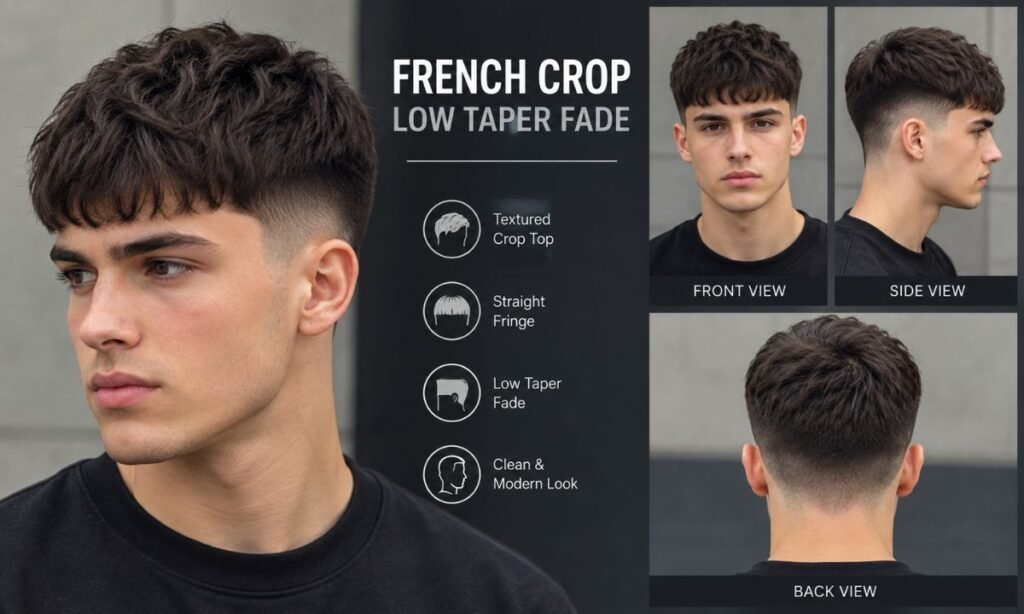
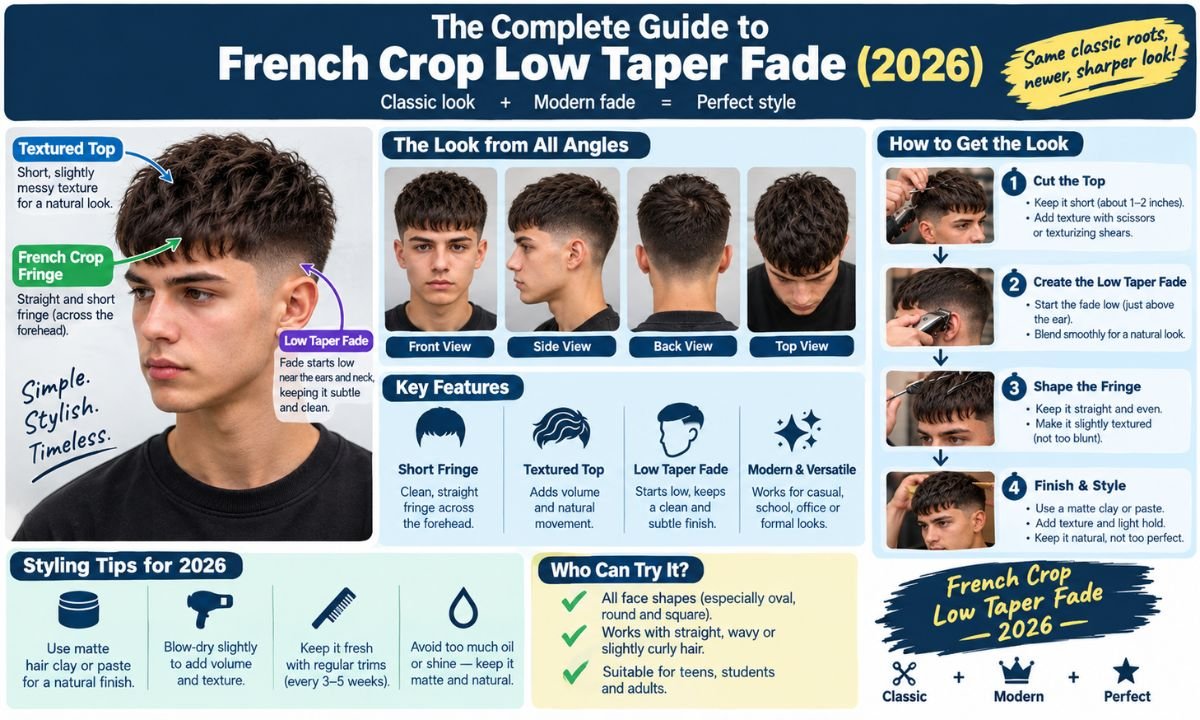
Short answer first: a French crop low taper fade pairs a short, textured top with a blunt fringe and a taper fade that fades low near the ears and neckline, not high up the sides. It’s clean, low maintenance, and works on almost every hair type. That’s the quick version. Now let’s get into everything else you need to know before you sit in the barber’s chair.
This cut has become one of the most requested styles for 2026, and for good reason. It’s sharp without trying too hard. It grows out gracefully. And it doesn’t demand twenty minutes of styling every morning. Let’s break down every angle of it, from suitability to styling to what to actually say to your barber.
What is a French crop low taper fade?
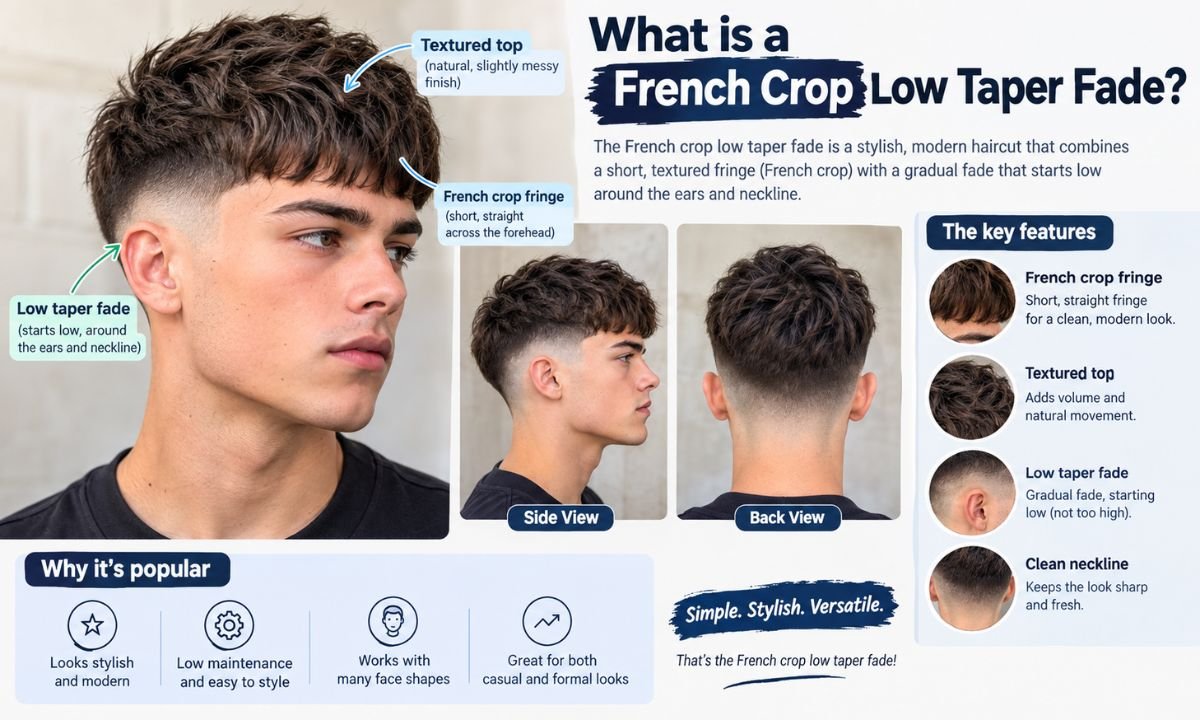
A French crop low taper fade is a short haircut where the top is cropped close, usually between half an inch and an inch, with a straight-across fringe sitting just above the eyebrows. The sides and back taper down gradually into a low fade, meaning the fade starts close to the ear and neckline rather than higher up near the temple.
Think of it as the neat, grown-up cousin of the classic crop. It keeps texture on top, adds a defined fringe for shape, and uses the low fade to keep things understated. You get contrast between the top and sides, but it’s subtle. Nobody’s going to mistake it for a flashy statement cut.
The French-crop top and fringe
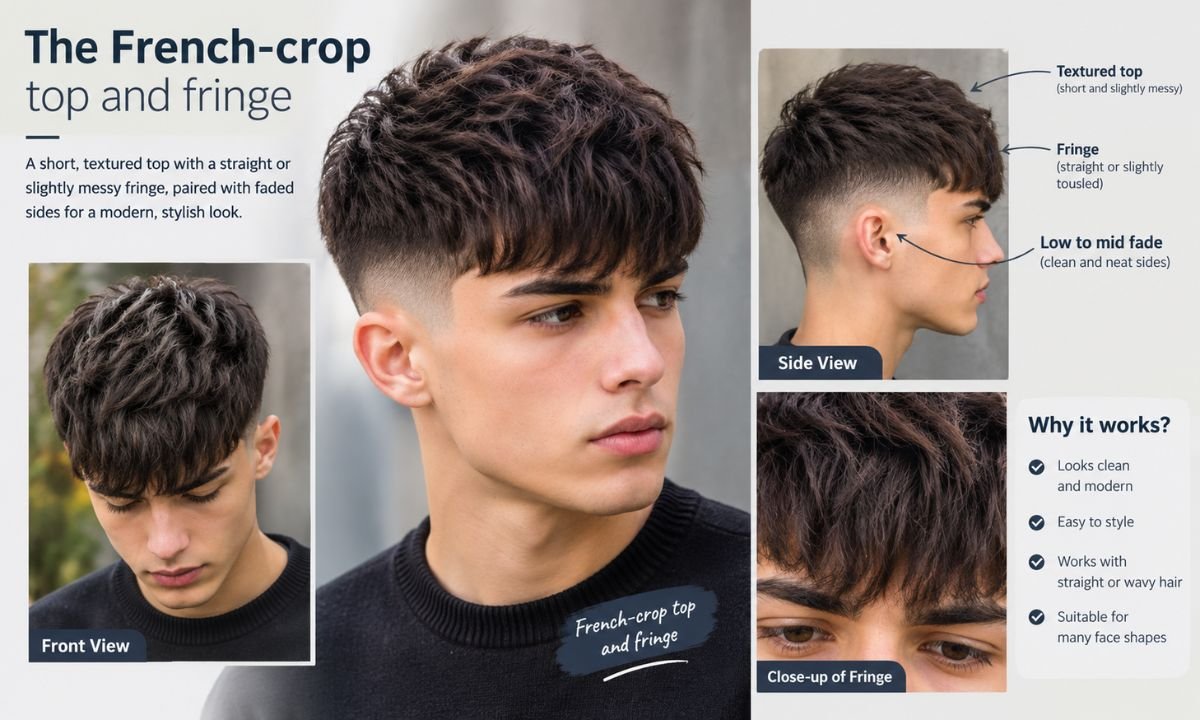
The top is where this style earns its name. French crop tops are cut short and blunt, then styled forward so the fringe falls flat across the forehead. This is different from a textured quiff or a pompadour, where the hair gets swept up or back.
You want enough length on top to create that fringe, usually around one to two inches at the front, tapering shorter toward the crown. The fringe itself gets cut straight or slightly textured at the ends, depending on how soft or sharp you want the line to look. A barber with sharp scissor-over-comb skills makes all the difference here.
What makes the taper “low”?
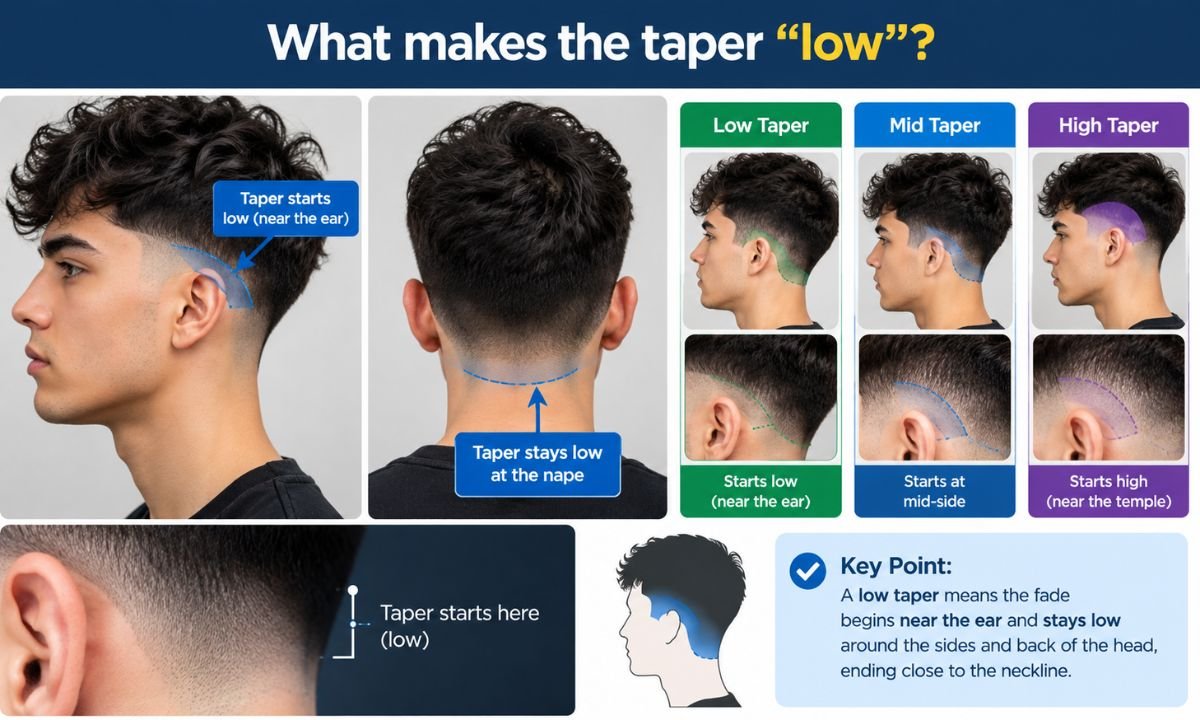
Here’s where people get confused. A taper and a fade aren’t technically the same thing, but they’re often blended together, and that’s exactly what happens with a low taper. The hair gradually shortens from the top down to the skin or a very short guard length, starting low, right around the ear line and nape.
Compare that to a mid or high fade, where the blending starts much higher, closer to the temple. A low taper keeps more length around the sides, so the overall look stays closer to your natural hair pattern. It’s subtle, professional, and doesn’t scream “fresh haircut” the way a high skin fade sometimes does.
Will a French crop low taper fade suit you?
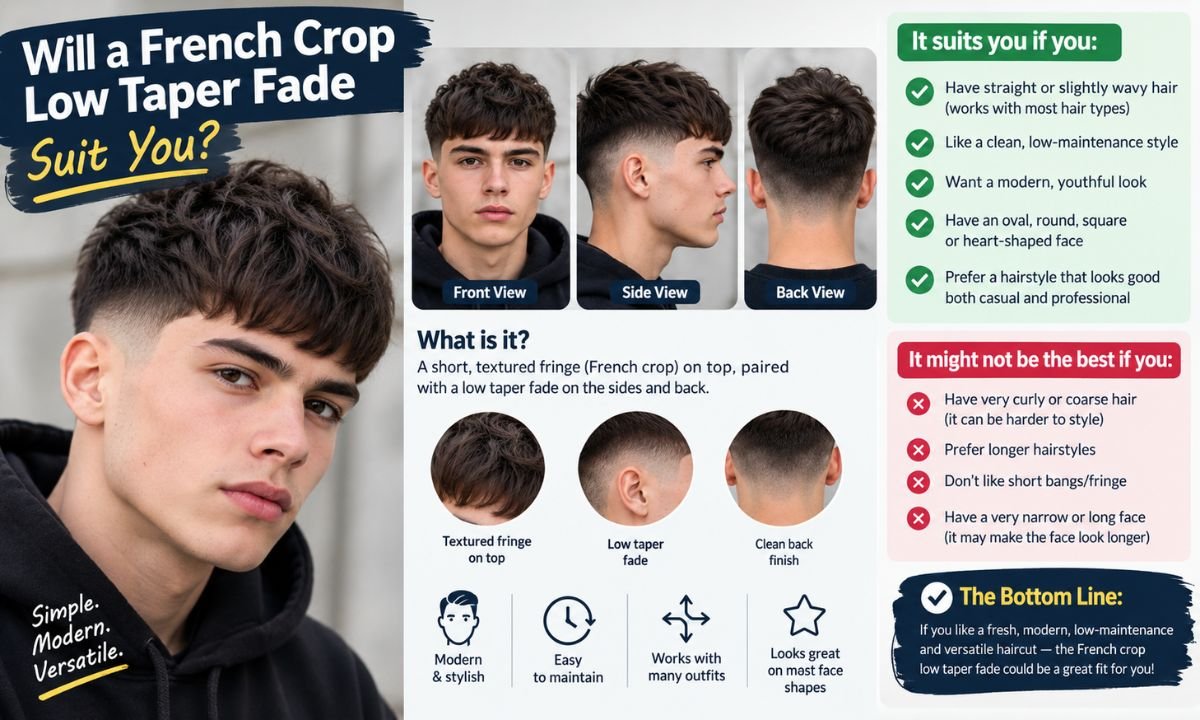
Honestly, yes, for most people. That’s part of why it’s so popular. But hair texture, density, and face shape all change how the finished look sits on you, so let’s go through the details instead of just saying “it suits everyone” and leaving you hanging.
The fringe is the trickiest part. It needs enough hair density up front to lay flat and look intentional. If you’ve got very fine or thinning hair right at the hairline, you might need a slightly different fringe shape than someone with thick, dense hair.
Suitability by hair type and density
Your hair’s natural texture decides how much daily effort the cut will need and how the fringe behaves. A good barber studies this before touching the clippers, and you should think about it too before you commit.
Straight or fine hair
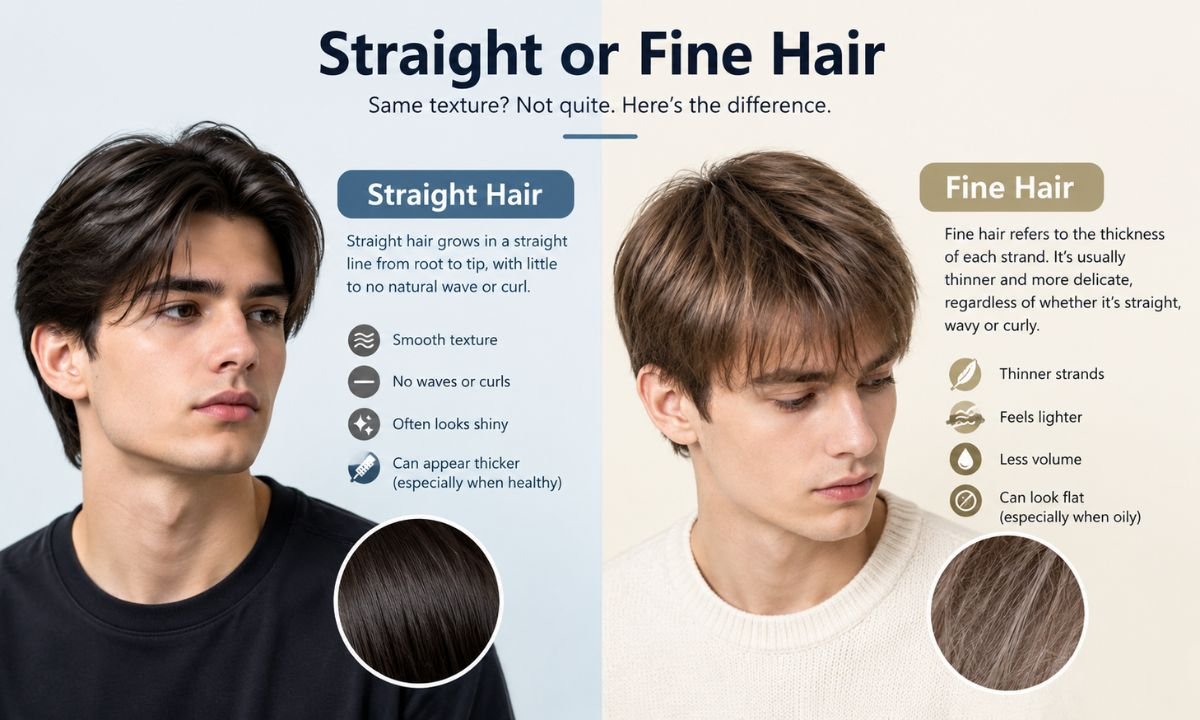
Straight hair gives you the cleanest fringe line and the sharpest overall shape. It falls flat naturally, so you won’t fight against flyaways or lift. The only catch is that fine, straight hair can look a bit flat on top if it’s cut too short, so ask your barber to leave a touch more length at the crown for subtle volume.
Wavy or thick hair
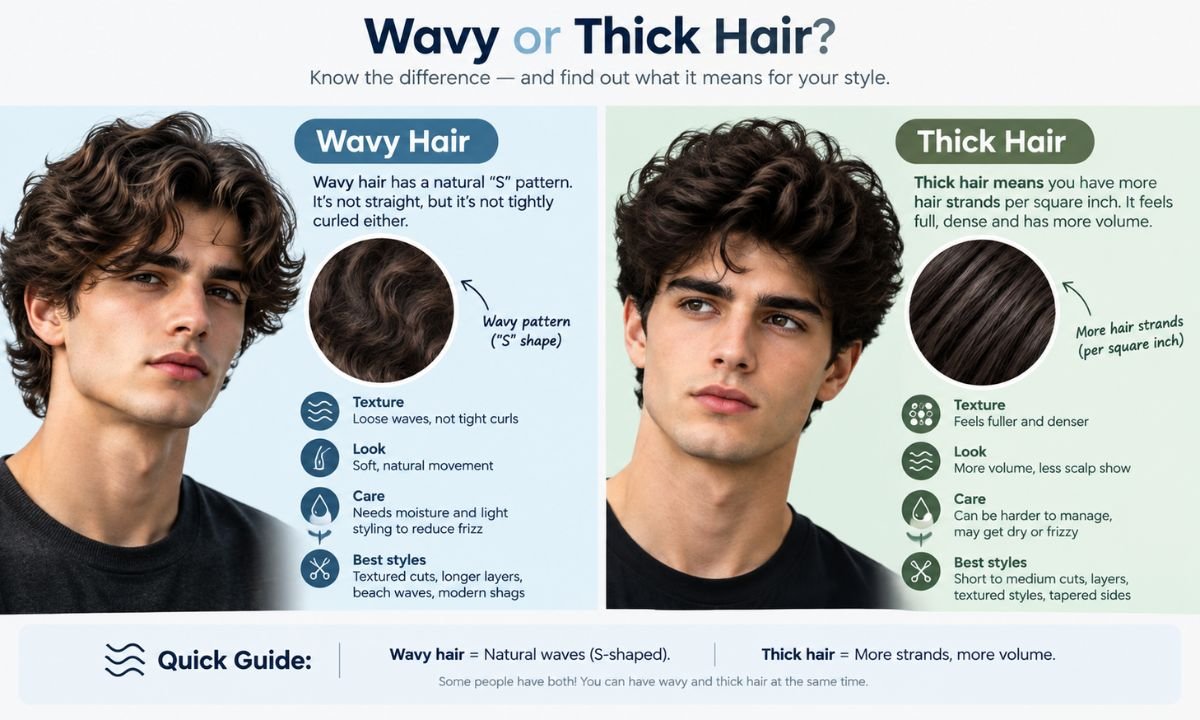
Wavy hair adds natural texture to the fringe, giving it that slightly broken, lived-in look that’s trending right now. Thick hair holds shape well through the day, though it may need thinning shears on top so it doesn’t puff up. This combination is arguably the easiest to style, since the natural wave does half the work for you.
Curly or coily hair
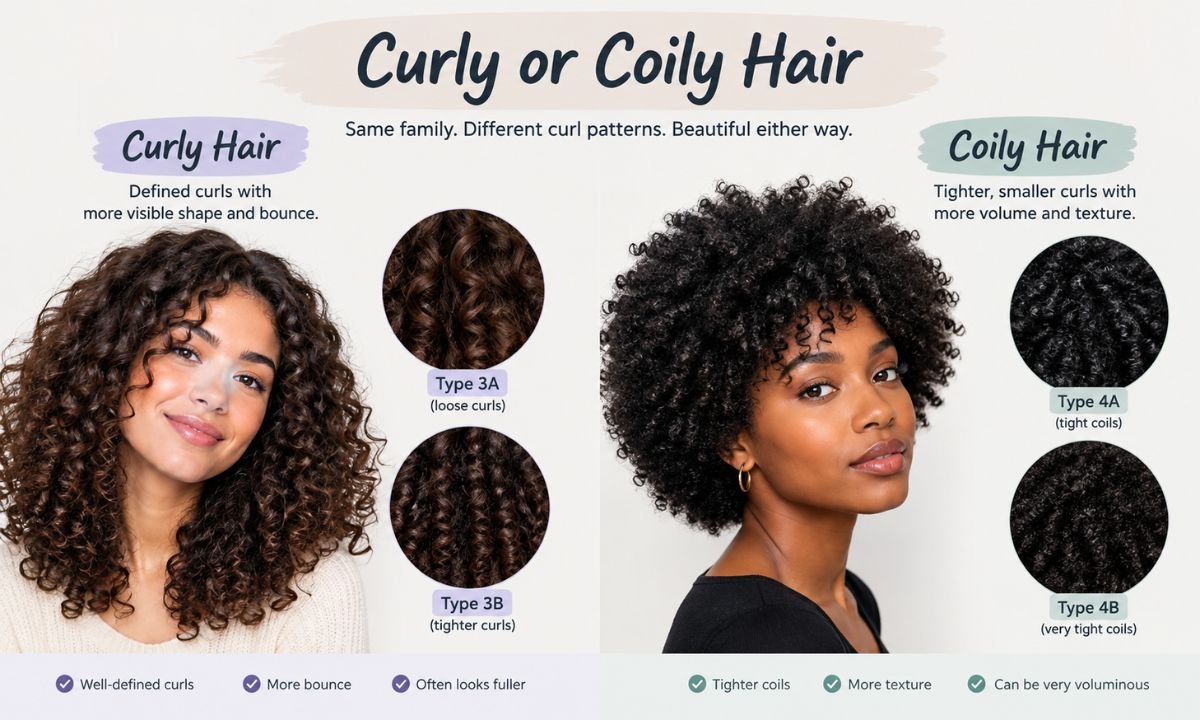
Curly and coily hair can absolutely rock a French crop, but the fringe usually needs to be a bit longer and shaped rather than cut razor straight. A rigid, blunt line fights against curl pattern and can look choppy within a week of regrowth. Ask for a curl-adapted fringe, where the ends are cut to follow the curl shape instead of against it.
Face shape, forehead and hairline considerations
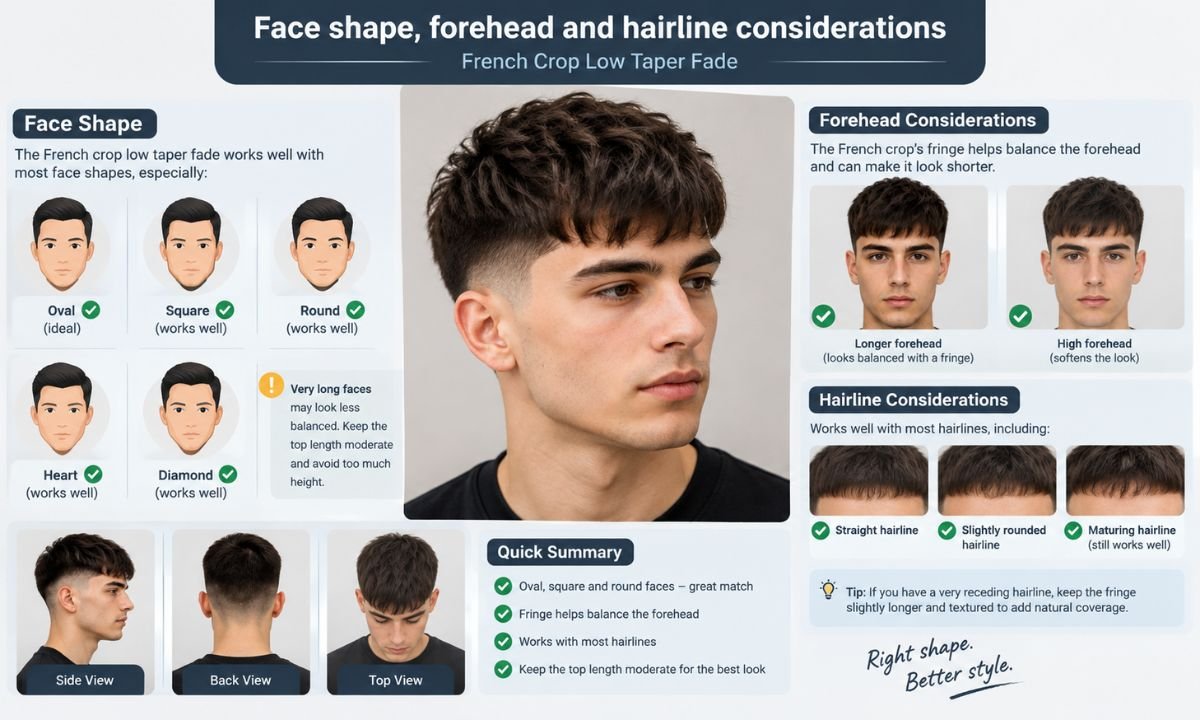
Face shape matters more with this cut than with most others because the fringe sits right across your forehead. Round faces usually benefit from a slightly longer, angled fringe that adds visual length. Square or angular faces can handle the straight, blunt fringe without any softening needed.
If you’ve got a smaller forehead, keep the fringe shorter so it doesn’t overwhelm your features. A larger forehead often looks better balanced with a fuller, slightly lower fringe. Your hairline shape (straight, rounded, or a widow’s peak) also changes how the fringe sits, so mention this during your consultation.
Cowlicks, crown thinning and sensitive skin
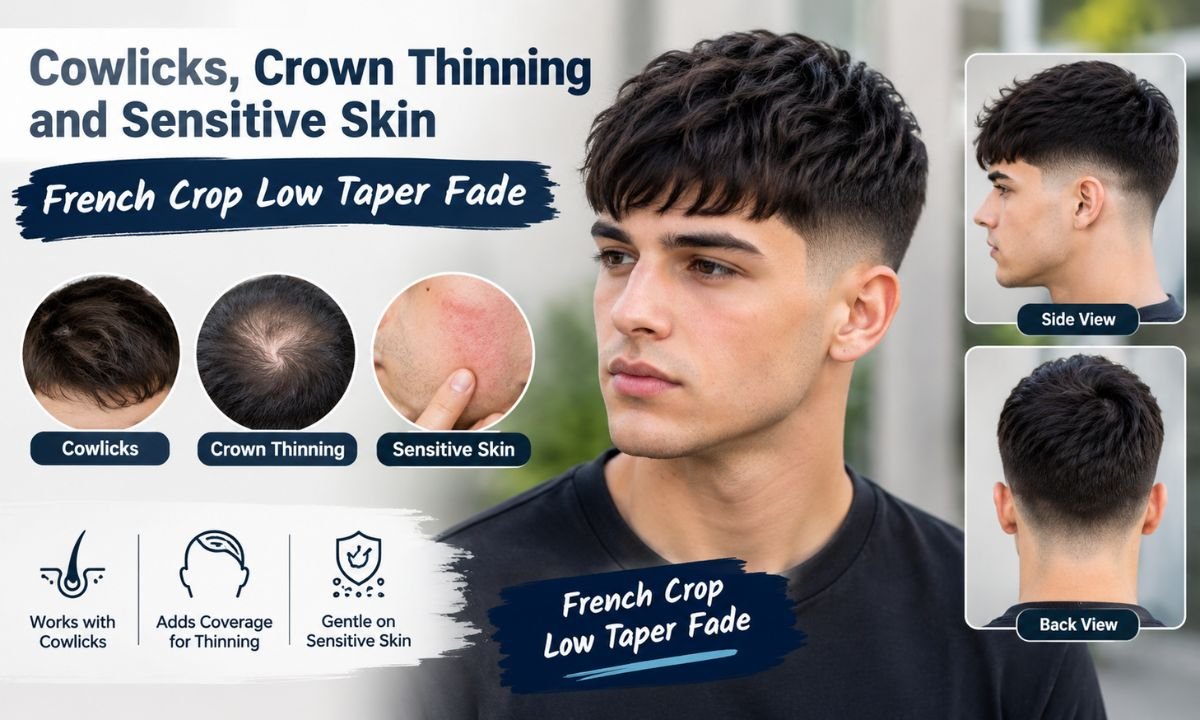
A cowlick near the front hairline can push the fringe in an odd direction if the barber doesn’t account for it. Usually, this means cutting the fringe slightly longer right at the cowlick so it has enough weight to lay down properly instead of sticking up.
If you’re dealing with crown thinning, a French crop can actually help, since the shorter length on top makes thinning less noticeable than longer styles would. And if you’ve got sensitive skin or a tendency toward razor bumps, stick with clipper guards instead of a skin-close finish on the taper, which we’ll cover more in the maintenance section below.
French crop low taper fade variations

This isn’t a one-size-fits-all haircut, and that’s honestly its biggest strength. Small tweaks change the whole vibe, from clean-cut office appropriate to edgy and textured. Let’s look at the main variations barbers are doing right now.
Fringe and top variations
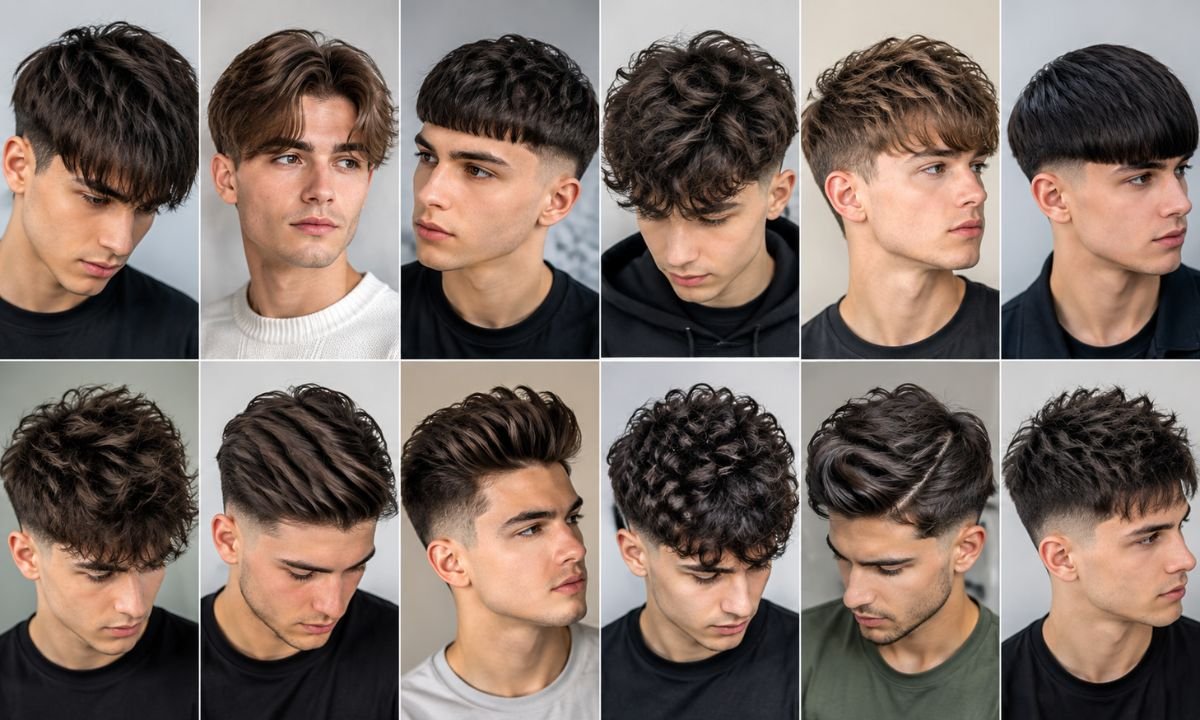
The classic straight-across fringe is timeless, but plenty of guys are opting for a slightly textured or “chopped” fringe edge instead, where the ends are point-cut rather than blunt. This softens the line and looks less severe. Some are also going shorter on top overall, closer to half an inch, for an even lower maintenance version.
Another popular twist is adding a hard part, a thin shaved line separating the fringe from the taper. It’s a small detail, but it sharpens the whole look and makes the transition between top and sides much crisper.
Variations for straight, wavy and curly hair
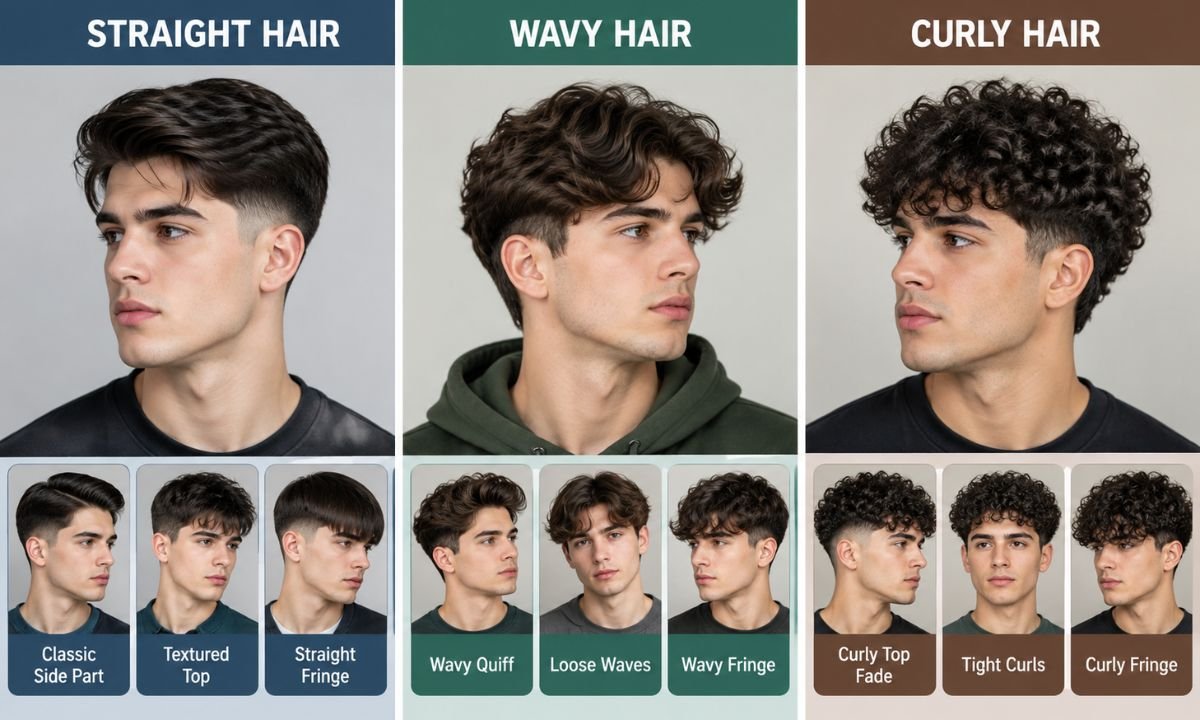
Straight hair versions tend to lean into that sharp, blunt fringe with a glassy finish. Wavy hair versions often go textured on top with a slightly tousled, matte finish instead of shine. Curly hair versions usually keep more length and rely on curl definition products rather than combing the fringe flat.
Each texture calls for a different finishing product too, which we’ll get into during the styling section. The point is, “French crop” isn’t a rigid template. It flexes to fit what your hair naturally wants to do.
Natural, shadow and skin-close taper finishes

On the sides, you’ve got three general finish options. A natural taper blends the hair down without going below a certain guard length, so there’s always some visible hair on the skin. A shadow fade goes a touch closer, leaving just a faint shadow of stubble near the bottom. A skin-close taper takes it right down to bare skin at the very lowest point.
Most guys going for a low, subtle look choose a natural or shadow finish, since it keeps the cut looking soft and blended rather than sharply contrasted. Skin-close finishes look sharper right after a cut but grow out faster and need more frequent trims to stay neat.
French crop low taper fade for different hair colors
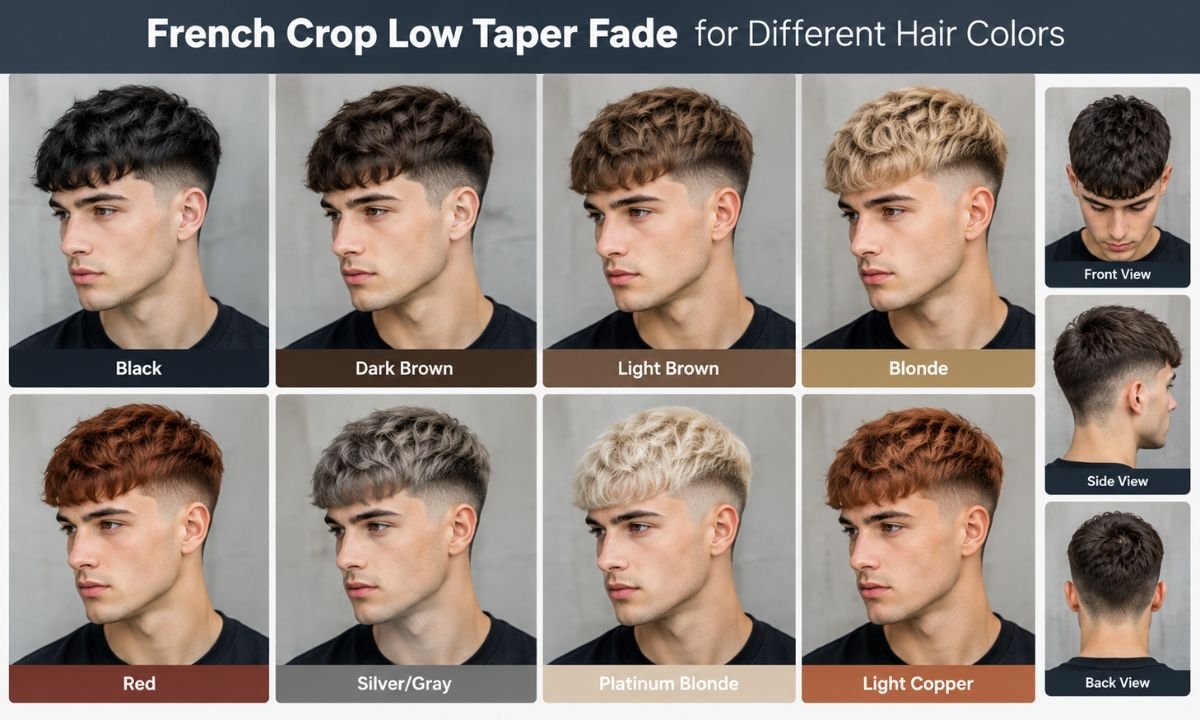
Hair color changes how visible the fade line looks and how much the fringe stands out against your skin tone, so it’s worth thinking about before your appointment.
Dark and black hair
Dark hair shows the taper line more clearly, since there’s more contrast between hair and skin near the fade zone. This is great if you want that crisp, defined look, but it also means any unevenness in the blend gets noticed fast. A skilled barber matters more here than with lighter shades.
Blonde and light brown hair
Lighter hair softens the fade naturally, so even a slightly closer finish looks gentle rather than sharp. Blonde hair also tends to show texture and movement better in the fringe, which works nicely with a piecey, textured top rather than a super glassy one.
Gray and salt-and-pepper hair
Gray hair pairs beautifully with a natural taper finish rather than skin close, since the contrast between gray hair and scalp is already fairly low. This cut is a favorite among guys transitioning into gray, since the short top keeps things looking deliberate rather than unkempt.
French crop low taper fade short hair

If your hair is already on the shorter side, or you just prefer minimal length, this cut adapts easily. You’ll keep about half an inch to three-quarters of an inch on top, with a shorter fringe that sits just above the brow rather than skimming it.
The shorter version is genuinely one of the lowest maintenance haircuts you can get. There’s barely anything to style, a quick run of product through damp hair and you’re done. It also holds its shape longer between barber visits since there’s less length to grow out and lose definition.
The trade-off is less versatility day to day. You can’t really change the look with styling the way you can with a slightly longer top. But if convenience is your priority, short and low is hard to beat.
Textured French crop low taper fade
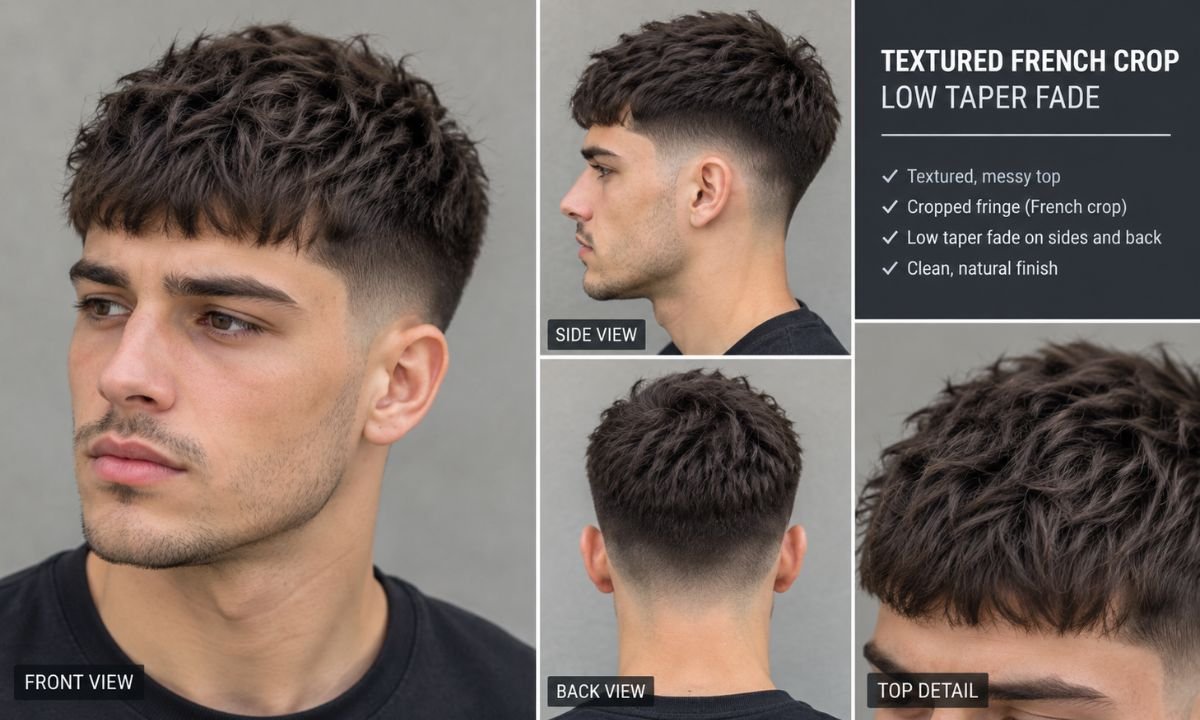
The textured version takes the same base shape but adds movement through the top using point cutting or texturizing scissors. Instead of a smooth, flat crop, you get a slightly choppy, piecey finish that looks effortless rather than precisely combed.
This variation works especially well if your hair has any natural wave, since the texture cutting enhances what’s already there instead of fighting it. It also hides regrowth better than a razor-smooth crop, because the broken lines don’t show uneven length as obviously.
Barbers usually achieve this with thinning shears on the mid-lengths and a soft, textured fringe edge rather than one clean line. Ask specifically for a “textured finish, not glassy” if this is the vibe you’re after, since some barbers default to the smoother version unless told otherwise.
Reference looks that inspire this cut
You’ve probably seen versions of this style on footballers, actors, and everyday guys on your feed, and there’s a reason it photographs so well. The fringe catches light nicely on camera, and the low taper keeps the sides from ever looking harsh in flash photography or under bright studio lighting.
Rather than chasing one specific celebrity’s exact haircut, focus on the elements that keep showing up across the best examples: a fringe that sits at a consistent length, sharp definition where the top meets the sides, and a taper that fades without any visible harsh lines. Those three details separate a great French crop from an average one, no matter whose face is wearing it.
French crop low taper fade comparisons
It helps to know how this cut stacks up against similar styles, especially if you’ve been scrolling through photos and can’t quite tell what separates one from another.
Low taper vs low fade, mid fade and high fade
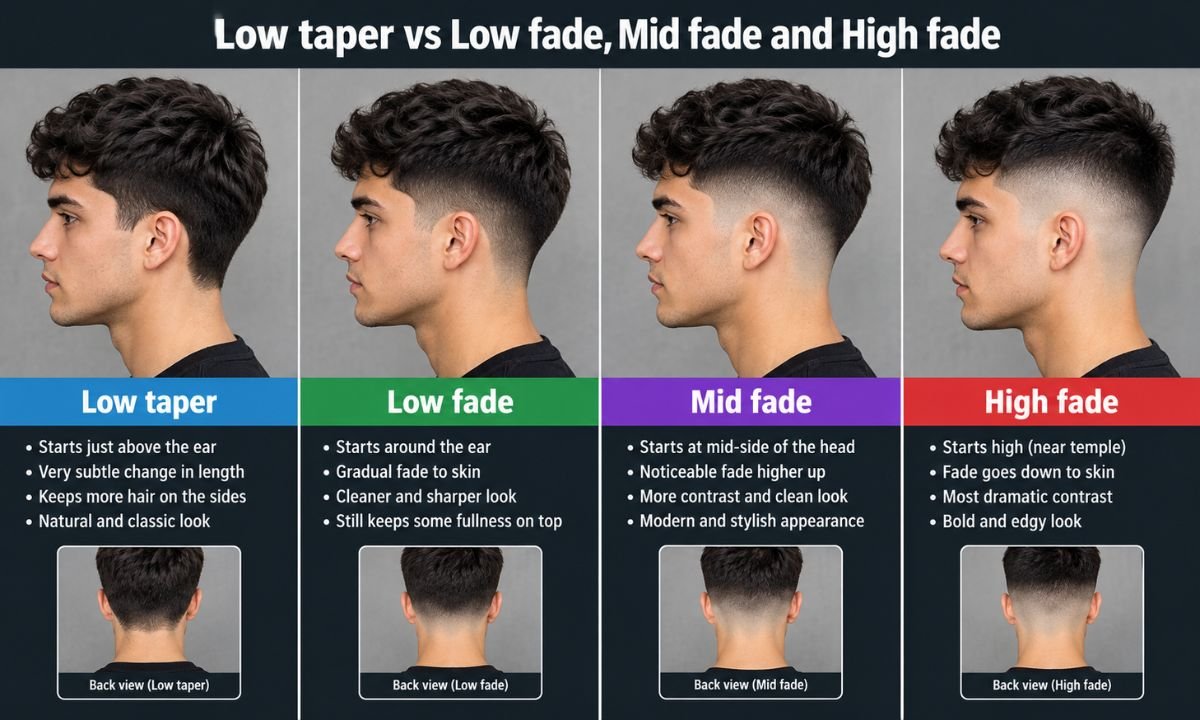
A low taper blends gradually and rarely reaches skin, keeping the transition soft. A low fade is similar in placement but tends to go closer to the skin near the bottom, creating slightly more contrast. Both start low, near the ear, which keeps the overall look understated compared to mid or high fades.
A mid fade starts the blend around the temple, giving more visible contrast between top and sides. A high fade pushes that starting point even further up, sometimes close to the crown, for maximum contrast. If you want a quieter, more professional look, low taper or low fade wins. If you want your haircut to make more of a statement, mid or high fade does that instead.
French crop vs textured crop, Caesar cut and crew cut
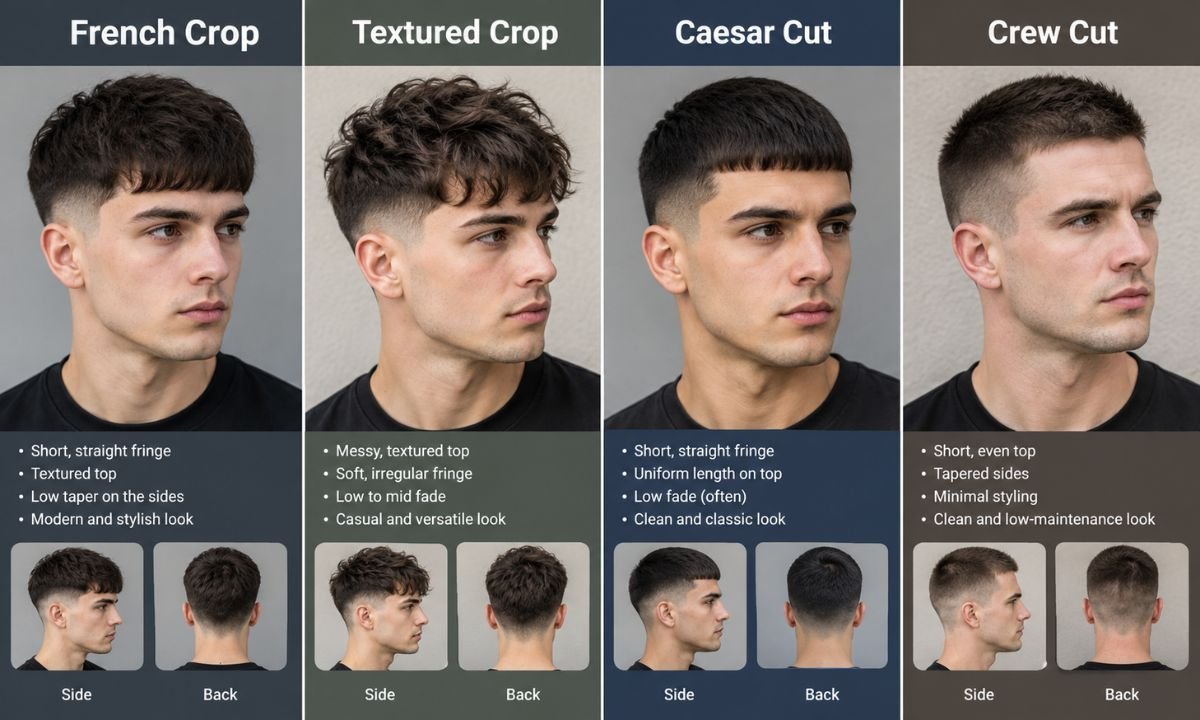
A textured crop is broader than a French crop. It just means a short, texturized top without a specific fringe requirement. A French crop is technically a type of textured crop, but it’s defined by that forward-styled fringe.
The Caesar cut looks similar at first glance since it also has a short fringe, but it’s typically cut uniformly short all over with minimal length variation and no taper or fade involved. A crew cut is even shorter and more uniform, with a slight taper but no fringe styling at all, just short hair combed forward or left natural. If you like the fringe but want almost no upkeep, Caesar cut is your alternative. If you want something even lower maintenance and don’t care about the fringe, crew cut is the move.
What should you ask your barber for?
This is where most French crop haircuts go wrong. Not because barbers don’t know the cut, but because the client doesn’t communicate the details clearly enough, and the barber makes assumptions.
The barber consultation checklist
Before you sit down, have clear answers ready for these points: how short you want the top (in inches, not just “short”), where exactly you want the fade to start (right at the ear, or a bit lower toward the neckline), and whether you want a natural, shadow, or skin-close finish. Also decide on the fringe length and whether you want it blunt or textured.
Bring up your hair type too, especially if you’ve got waves or curls, since the barber may need to adjust the fringe cutting technique. And always mention any cowlicks or growth patterns you’re aware of, since that changes how they’ll approach the front section.
A copyable barber script
Feel free to use this almost word for word: “I’d like a French crop with a low taper fade. Keep the top around an inch, textured, with a straight fringe just above my eyebrows. For the sides, start the taper low, right around my ear, and blend it down to a natural finish, not skin close. Keep the back matching the sides.”
Adjust the specifics based on your own preferences from the sections above, but this gives your barber a clear, specific brief instead of vague direction that leaves room for misinterpretation.
How to use reference photos without getting the wrong cut
Reference photos help enormously, but only if you use them right. Don’t just show a photo and say “this.” Point out the exact elements you like: “the fringe length in this photo” or “how low the fade starts here.” Photos alone often mislead barbers because lighting, hair texture, and even hair color can make the same haircut look different from person to person.
If possible, bring two or three photos showing different angles, front, side, and back, so your barber gets the full picture rather than guessing at what they can’t see in a single shot.
How to style a French crop low taper fade
One of the biggest selling points of this haircut is how little daily effort it needs. Still, a few smart habits make the difference between looking sharp and looking like you just rolled out of bed.
A five-minute everyday styling routine
Start with slightly damp hair, towel dried but not soaking. Apply a small amount of product (dime-sized, roughly) and work it through evenly with your fingers, focusing on the fringe and top. Use a comb or your fingers to push the fringe forward and flat, then blow dry briefly on a cool setting to lock the shape in place.
That’s genuinely it. No elaborate brushing, no heat styling tools required for most hair types. The whole routine takes less time than making your morning coffee.
Morning routine vs night-before prep
Some guys prefer prepping the night before, applying a light leave-in cream after washing so the hair sets into shape overnight. This works particularly well for wavy or curly textures, since it reduces the “fighting the hair” phase in the morning. If you’re a straight-hair type, you can usually get away with a quick morning-only routine without any night prep at all.
Which product type should you use?
Matte clay or paste works best for textured, piecey finishes, giving hold without shine. A pomade, especially a water-based one, suits the smoother, glassy fringe look if that’s your preference. Curly hair types often do better with a lightweight curl cream that defines rather than flattens the natural pattern.
Avoid heavy waxes unless your hair is particularly unruly, since they can weigh down fine or thin hair and make the top look flat instead of textured.
Styling mistakes and weather adjustments
The most common mistake is using too much product, which makes the fringe look greasy rather than defined. Start small; you can always add more, but you can’t easily remove excess once it’s in.
Humid weather can cause frizz or lift, especially with wavy or curly textures, so a light anti-humidity spray or serum helps hold the shape through the day. Cold, dry weather tends to make hair static and flyaway, so switching to a slightly heavier cream in winter months keeps things controlled.
Maintenance, grow-out and scalp care
This cut looks its sharpest in the first two weeks after a fresh trim, but how you maintain it between visits determines whether it still looks intentional in week four.
How often should it be trimmed?
Most people need a trim every three to four weeks to keep the fade sharp and the fringe at a manageable length. If you’ve got a skin-close taper finish, you might need visits closer to every two to three weeks, since that finish grows out and loses its clean line faster than a natural taper.
Keeping the cut presentable between visits
As the fringe grows, it’ll start falling into your eyes, which is usually the first sign you need a trim. In the meantime, you can push it slightly to the side for a couple extra days of wearability before it truly needs cutting. The taper on the sides will soften naturally as it grows, which actually looks fine for a while since a low taper has less contrast to lose in the first place.
Regular brushing or combing keeps the top looking neat rather than matted, especially if you’re using heavier products. And don’t skip washing every couple of days; product buildup makes hair look dull and can clog things up at the scalp.
Close-cut irritation and when to reconsider a skin finish
If you’ve noticed razor bumps, ingrown hairs, or irritation around the neckline after a skin-close taper, that’s your sign to switch to a natural or shadow finish instead. Sensitive skin doesn’t always react well to that level of closeness, especially with repeated visits over months. A good barber will happily adjust this for you without judgment; it’s a common request.
Should you get this haircut?
If you want something sharp but not flashy, low effort but still stylish, and adaptable to pretty much any hair texture, then yes, this is a genuinely safe bet. It suits professional settings just as easily as casual ones, which is rare for a haircut with this much personality.
The only people who might want to look elsewhere are those with very fine hair up front who don’t love the idea of a fringe, or anyone who prefers zero daily styling whatsoever, even the five-minute routine described above. For nearly everyone else, it’s a strong, reliable choice.
Frequently asked questions
Which fade is best for French crops?
A low taper or low fade works best, since it keeps the focus on the fringe and top rather than competing with a high-contrast fade on the sides.
Is fade haram in Islam?
This is a debated topic among Islamic scholars, and opinions vary depending on interpretation. Many scholars permit fades as long as the cut doesn’t resemble specific styles considered impermissible in certain traditions. If this matters to you, it’s worth asking a trusted local scholar for guidance specific to your situation.
What is a French crop with a low taper?
It’s a short, textured haircut with a blunt or textured fringe on top, paired with a gradual fade that starts low, near the ear and nape, rather than higher up the head.
Is a French crop attractive?
Yes, for most face shapes and hair types, it’s widely considered a flattering, modern cut. It works well because it frames the face without being overly dramatic.
How do I ask for a French crop low taper fade at the barber?
Use the script provided earlier in this guide: mention the top length, fringe style, and exactly where you want the fade to start and how close to finish it.
How long does a French crop low taper fade take to grow out?
You’ll notice the fringe needing attention around the three to four week mark, though the overall shape stays wearable for five to six weeks before it loses its defined structure.
Can I do a French crop low taper fade at home?
It’s possible with clippers and guards, but the fringe cutting and taper blending both require precision that’s tough to nail without barber experience. Most people get better, more even results going to a professional, at least for the first few cuts.
Does a French crop low taper fade work with a beard?
Yes, it pairs well with most beard styles, especially a well-groomed short to medium beard, since the low taper naturally blends into beard fades without competing for attention.
What’s the difference between a French crop and a fringe haircut?
A fringe haircut is a general term for any style with hair cut straight across the forehead. A French crop is a specific version of that, combining the fringe with a short, textured top and a taper or fade on the sides.
How much does a French crop low taper fade cost?
Pricing varies by region and barber experience, but expect to pay roughly the same as any premium fade haircut, often slightly more than a basic trim since the fringe cutting takes extra precision and time.
Can women get a French crop low taper fade?
Yes, though it’s more commonly styled on men, the same short-top-with-fringe concept works on shorter women’s cuts too, sometimes styled with a bit more length and softness in the fringe.
Does a French crop suit thinning hair?
It often works well for early thinning, since the short length on top makes reduced density far less noticeable than longer, flatter styles would.
What’s the best age for a French crop low taper fade?
There’s no age restriction here. It works equally well on teenagers and older men, since the cut flatters based on hair type and face shape rather than age.
How do I fix an uneven fringe at home?
Small unevenness can be trimmed carefully with sharp scissors over a comb, cutting tiny amounts at a time, but anything more than a slight adjustment is best left to your barber at the next visit.
Final Thoughts
The French crop low taper fade earns its popularity honestly. It’s easy to maintain, flattering across most hair types and face shapes, and versatile enough to dress up or down depending on the occasion. Whether you go textured or smooth, short or slightly longer, natural taper or shadow finish, there’s a version of this cut that’ll work for you.
Bring a clear plan to your next barber appointment, use the script above if you need it, and don’t be afraid to ask questions before the clippers come out. Get the details right at the start, and this cut will reward you with weeks of low-effort, high-payoff style.
