

You want a cut that looks sharp but doesn’t need a daily battle with your hair. You also don’t want to walk out of the shop with a bowl on your head.
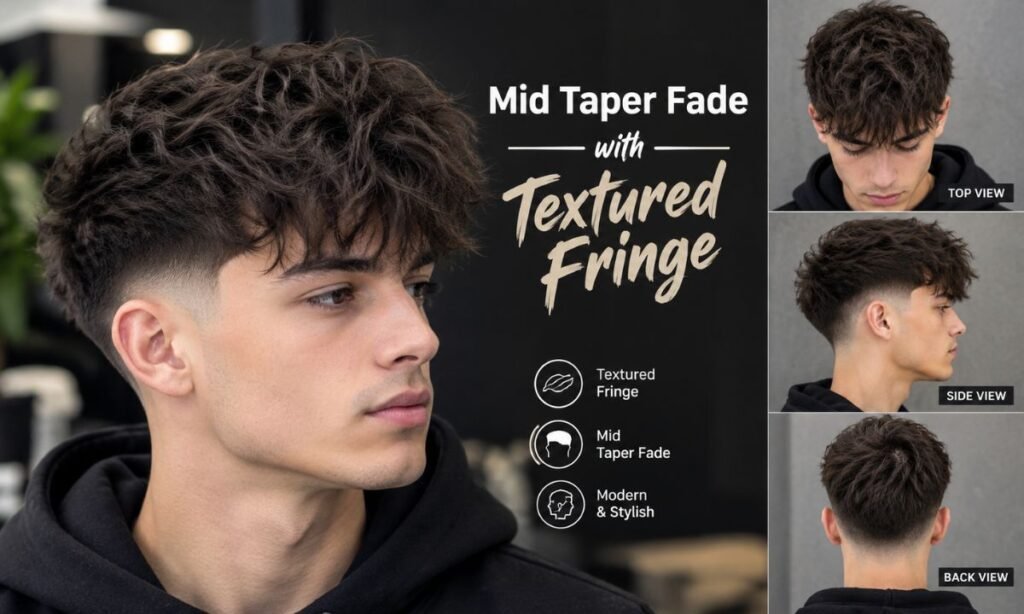
A mid taper fade with textured fringe gives you exactly that. The sides get a clean, gradual mid taper around the temple and sideburn. The top keeps a broken, choppy fringe that falls forward with natural movement.
A mid taper only shortens hair around the ears and neckline, so your upper sides stay fuller. A full mid fade cuts away far more weight, which gives a harder, more skin-close look. That one difference decides whether the cut feels soft and wearable or loud and high-maintenance.
This guide walks you through the shape, the right fringe length for men, the exact words to tell your barber, and a simple styling routine. You’ll also see how it behaves on straight hair, wavy hair, and thick hair. Grab a coffee and let’s get into it.
Textured Fringe and Mid Taper: Three Useful Views
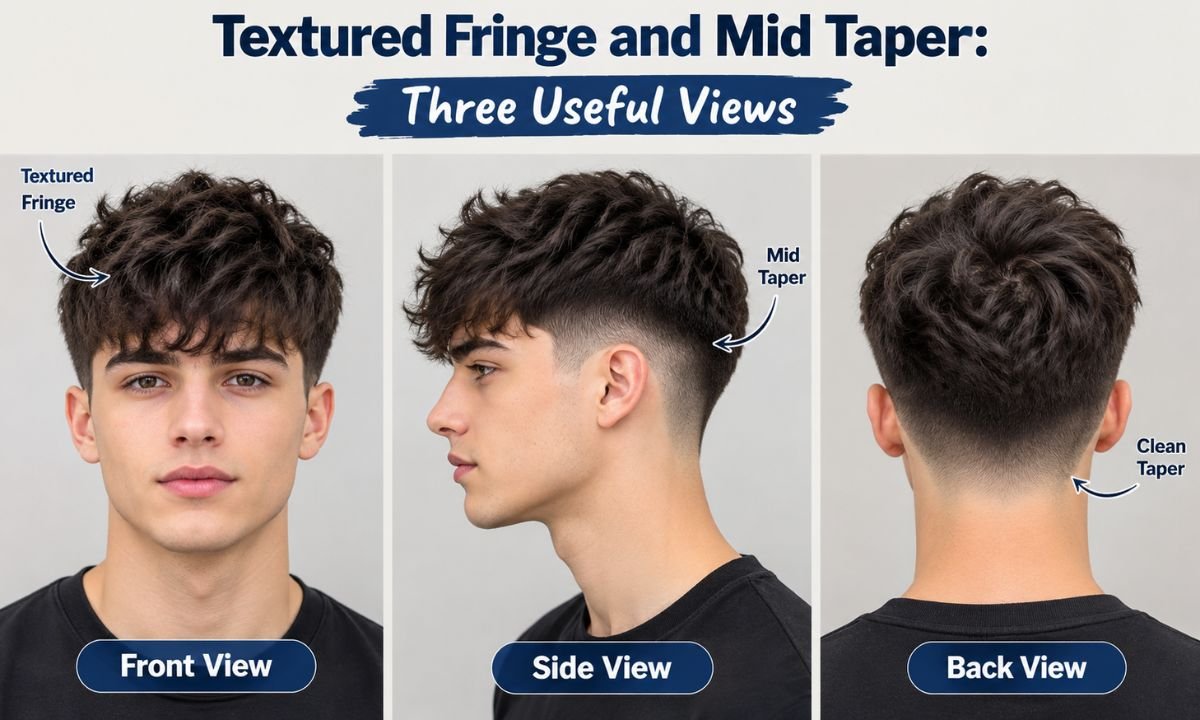
Pictures sell this haircut, but most people only look at the front. You need three angles to judge it properly. Front, side, and back each tell you something different.
From the front, you should see a short textured fringe that sits just above the brows. The ends look separated and slightly jagged, not ruler straight. That broken edge is what stops the cut from looking flat.
From the side, check where the taper begins. A true mid taper haircut for men starts its fade near the middle of the head, right around the temple. The upper sides should still hold some length so the head shape looks balanced.
From the back, look at the tapered neckline. It should shrink softly toward the nape, with no harsh line cutting across. A low taper at the nape often looks the most natural here.
| View | What to look for | Red flag |
| Front | Separated ends, brow-level length | A blunt, flat line |
| Side | Taper starting at the temple, fuller upper sides | A fade that climbs too high |
| Back | Soft tapered neckline blending into the nape | A square, boxy edge |
Save pictures from all three angles before you visit the shop. Your barber can’t read your mind, but a good photo set comes close. It also keeps you from describing a vague vibe and hoping for the best.
What “Textured Fringe” Actually Means
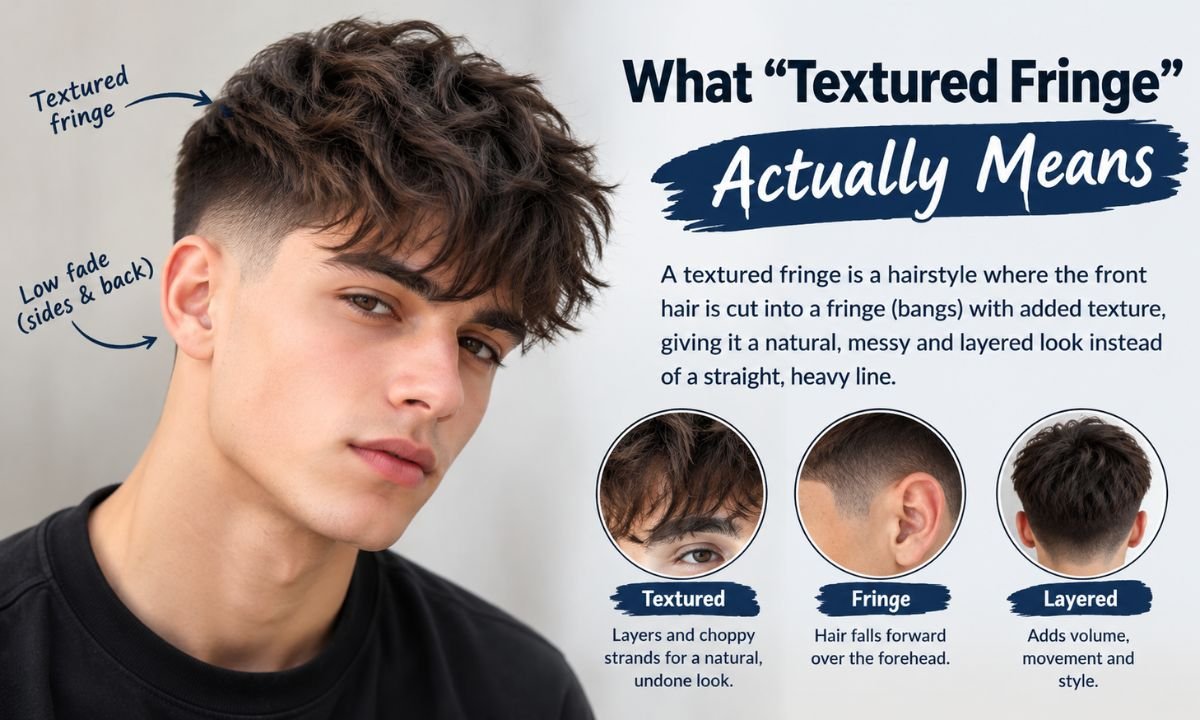
People throw the term around loosely. A textured fringe haircut simply means the front hair is cut with built-in breaks, so it moves instead of lying in one heavy sheet. Think of a feather rather than a curtain.
Barbers get that look with point cutting and a careful texturizing technique. They snip into the ends at an angle instead of cutting straight across. The result is choppy texture with tiny gaps that let light and air through.
You’ll see names like messy textured fringe, choppy fringe haircut, and forward fringe haircut. They overlap a lot. The common thread is forward movement, separated ends, and a finish that looks lived in.
A point-cut fringe works differently from simple thinning. Thinning shears can remove too much internal bulk and leave frizzy, weak ends. Point cutting keeps the hair weight where you need it and breaks up only the edge.
Compare your preferences first
Before you book, decide how bold you want the front to look. Some guys love a rugged, messy textured fringe. Others prefer a tidy, short textured fringe that fits an office.
Ask yourself two quick questions. How much time will you spend styling each morning? How much hair density do you have to work with?
| If you want | Choose | Styling effort |
| Casual and rough | Choppy fringe haircut with deep point cutting | Low |
| Neat and polished | Short textured fringe, light separation | Medium |
| Maximum volume | Longer fringe with root lift | High |
| Easy grow out | Forward fringe with soft ends | Low |
Once you know your pick, the rest of the haircut gets simple. You can describe it clearly and avoid surprises. Honestly, this one step prevents most bad haircuts.
Why Pair It with a Mid Taper?

The top gets all the attention, but the sides do the quiet work. A mid taper frames the face and makes the fringe look intentional. Without it, textured hair can look unfinished.
A taper also keeps things grown up. A men’s modern taper haircut gradually shortens hair, so you avoid the sudden jump a skin fade creates. That softness suits work, weekends, and weddings.
Then there’s the practical side. The taper only touches the sideburn, temple, and nape, so the haircut with fuller upper sides grows out gracefully. You won’t look shaggy at week three the way you might with a high skin fade.
Mid taper fade vs mid fade with fringe

These two get mixed up constantly. A mid taper fade is localized, which means the shortening happens near the edges. A mid fade starts at the same height but removes much more hair across the sides.
Here’s an easy way to picture it. A taper is a gentle slope. A full fade is a steep ramp.
| Feature | Mid taper | Mid fade |
| Coverage | Around ears, temple, nape | Across most of the sides |
| Look | Soft and natural | Bold and high contrast |
| Upkeep | Every 4 to 5 weeks | Every 2 to 3 weeks |
| Best for | Office, daily wear | Statement cuts |
If you’re unsure, start with the taper. You can always ask for a shorter fade next visit. Going the other way takes months of patience.
Length: How Much Fringe Do You Need?
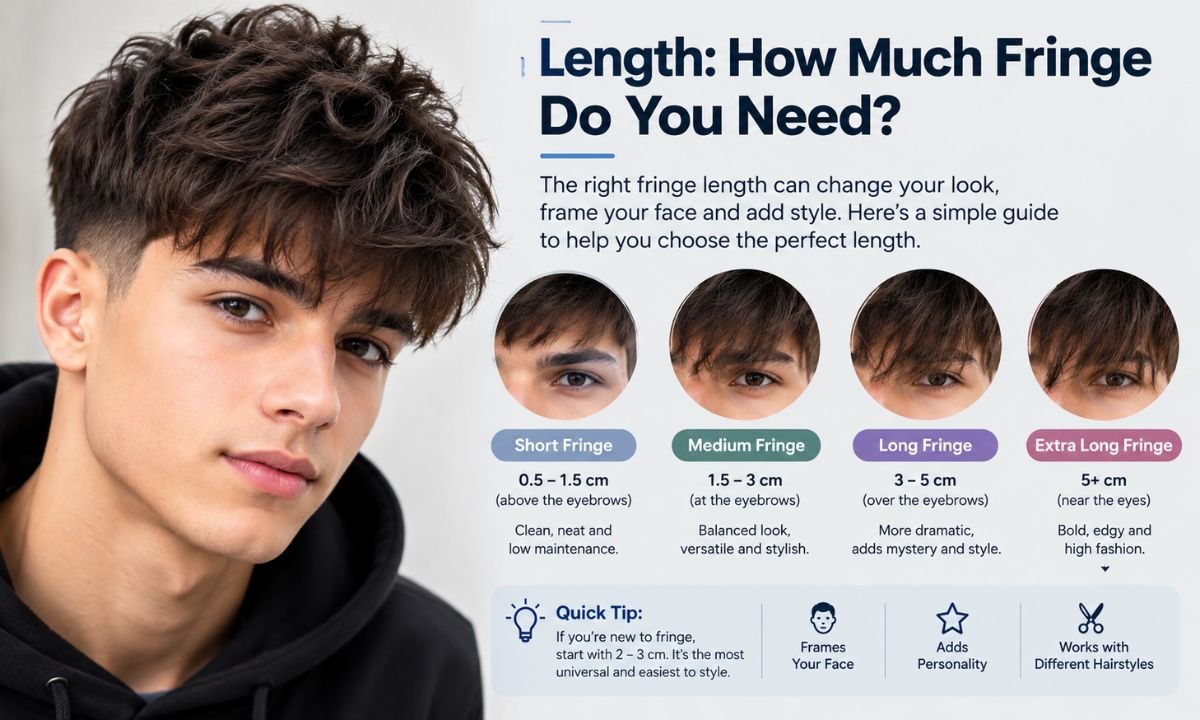
How long should a textured fringe be? Most men land between 2 and 4 inches on top, measured in dry hair length. That’s long enough to push forward and short enough to stay out of your eyes. Aim for the fringe to end near the middle of your forehead.
Wet hair fools you. It stretches, so a fringe that looks perfect in the chair can jump up once it dries. Always judge dry hair length before you approve the final trim.
Your hair type changes the number. Wavy hair shrinks as it dries, so it often needs a bit more length. Fine hair looks best slightly shorter, because long strands flop and lose shape.
| Hair type | Suggested fringe length | Why |
| Straight | 2 to 3 inches | Holds shape without drooping |
| Wavy | 3 to 4 inches | Allows for shrinkage |
| Thick | 2.5 to 3.5 inches | Easier to manage and thin |
| Fine | 2 to 3 inches | Prevents flat, limp ends |
If you’re stuck between two lengths, go longer. Your barber can remove an inch in a minute, but nobody can add it back. That small bit of patience saves a lot of regret.
What to Ask Your Barber
This is where most people slip. They say “short on the sides, longer on top” and hope the best happens. That sentence fits ten different haircuts.
Use specific words instead. Walking in with photos and a clear script helps a barber see exactly what you picture. Here’s a version you can steal:
- “I’d like a mid taper that starts at the temple and fades into my sideburns.”
- “Please keep the upper sides fuller, with no skin fade.”
- “Give me a textured fringe about 3 inches long, cut with point cutting.”
- “I want separated ends and no blunt line across the front.”
- “Add a low taper at the nape so the neckline looks soft.”
Then add one personal detail. Mention your hair texture, how fast it grows, and how you usually style it. A barber who knows you blow-dry every day will cut differently from one who air-dries.
If you’re asking how to ask a barber for a textured fringe, the magic phrase is “remove weight, not length.” It tells them to shape the ends and keep the top length intact. It also warns them against over-thinning.
Bring a photo and point to what you like. Point to what you don’t like too, such as a flat front edge. That honest feedback gives your barber a map instead of a guess.
Three-Step Styling Routine
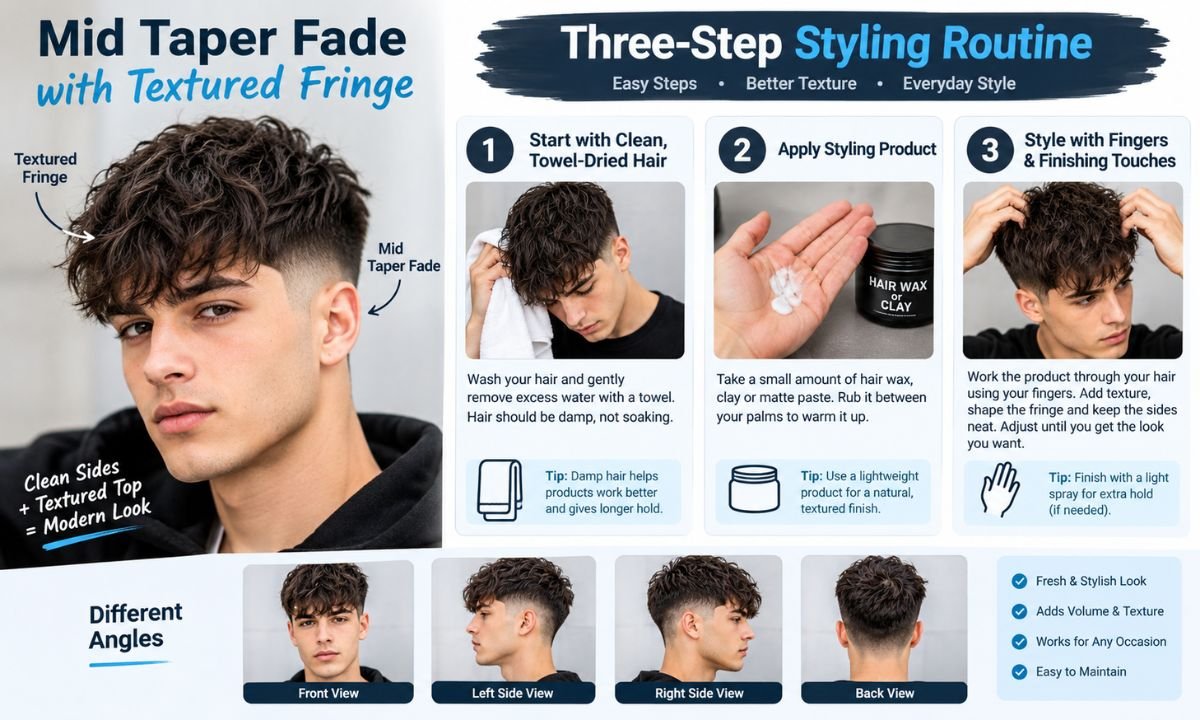
Styling shouldn’t feel like a chore. This textured fringe styling routine takes about five minutes once you learn it. Here’s the whole thing, step by step.
Step 1: Start with damp hair. Towel dry until your hair stops dripping. Work in a little pre-styler or texture foam from root to tip, because that gives your style a base to grip.
Step 2: Blow-dry forward. Use medium heat and point the nozzle down. Lift the roots with your fingers for root lift, then push the fringe forward while you dry. Blow-drying in that direction trains the hair to fall where you want.
Step 3: Finish with product. Rub a pea-sized amount of matte clay between your palms until it warms up. Run it through the top with your fingers, then pinch the ends for a piecey finish. Add a dusting of texture powder if you want extra grip.
That’s it. No fancy tools, no ten-step ritual. The secret is using less product than you think you need.
If your hair feels crunchy, you’ve used too much. Rinse your hands and start over with half. A light touch gives the natural movement hairstyle look people actually want.
Straight vs Wavy vs Thick Hair

The same cut behaves differently on every head. That’s why a photo of your favorite actor doesn’t always translate. Let’s break it down by hair texture so you know what to expect.
Straight hair
Mid taper fade with textured fringe for straight hair is the easiest version to pull off. Straight strands show every clean line, so the taper looks crisp. The challenge is that the fringe can fall flat.
Ask for deeper point cutting so the ends break apart on their own. Add texture powder at the roots for lift. A textured crop with mid taper works especially well here because the shorter length holds its shape.
If your straight hair is also fine hair, keep the fringe on the shorter side. A textured fringe for fine hair needs less length and lighter product. Heavy clay will weigh it down fast.
Wavy hair
Mid taper fade with textured fringe for wavy hair looks great because the natural wave pattern does half the work for you. The bends create separation without effort. You just need to guide them.
Leave extra length so waves have room to curl. Skip heavy thinning, since it can wreck the wave control you rely on. A bit of frizz control cream on damp hair helps the pattern stay neat.
What’s the best fringe length for wavy hair? Usually around 3 to 4 inches. Let it air-dry about 80 percent, then finish with a quick blast of warm air and a touch of matte paste.
Thick hair
Mid taper fade with textured fringe for thick hair needs a careful plan. High hair density can make the top feel like a helmet. The goal is to remove internal bulk without touching the visible length.
Ask your barber to thin from the inside using texturizing technique, not by chopping the ends flat. That’s how to reduce bulk in thick fringe hair while keeping weight where it counts. It also keeps the forward movement intact.
The taper helps you here too. By keeping the upper sides fuller, you balance a heavy top so the head doesn’t look top heavy. Use matte clay instead of light paste, because thick strands need stronger hold and finish.
Mid Taper Fade with Textured Fringe Asian
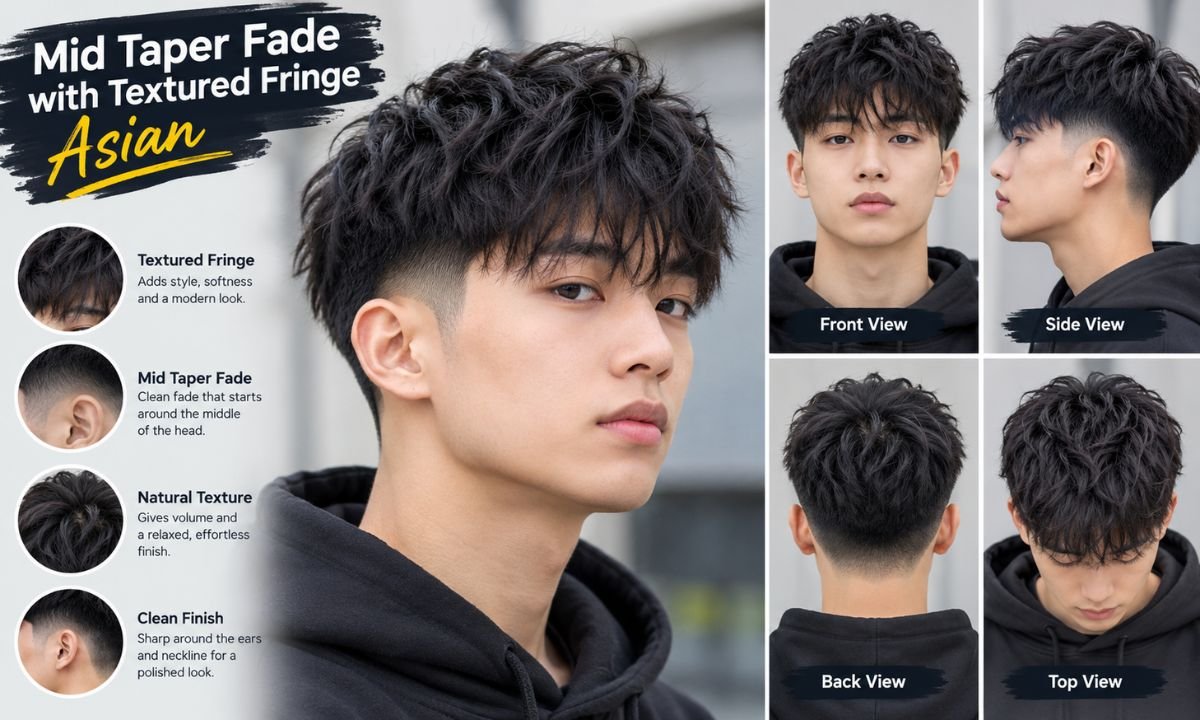
Asian hair often grows straight, dense, and strong. That’s great for holding a shape, but it can also stick out at odd angles. A mid taper fade with textured fringe Asian style works best when the barber respects that hair density.
The key is removing bulk inside without making the ends wispy. Ask for careful point cutting and a separated front that falls forward. A slightly longer top, around 3 inches, gives you room to style.
Product choice matters more than people admit. A strong matte clay or matte paste keeps coarse strands in place all day. Blow-dry forward first to settle any stubborn cowlicks.
For growth patterns, talk to your barber about the crown and the front hairline. Cowlicks change how a fringe lies, and a good barber cuts around them. Small tweaks here make the difference between a clean look and a daily fight.
Mid Taper with Textured Top
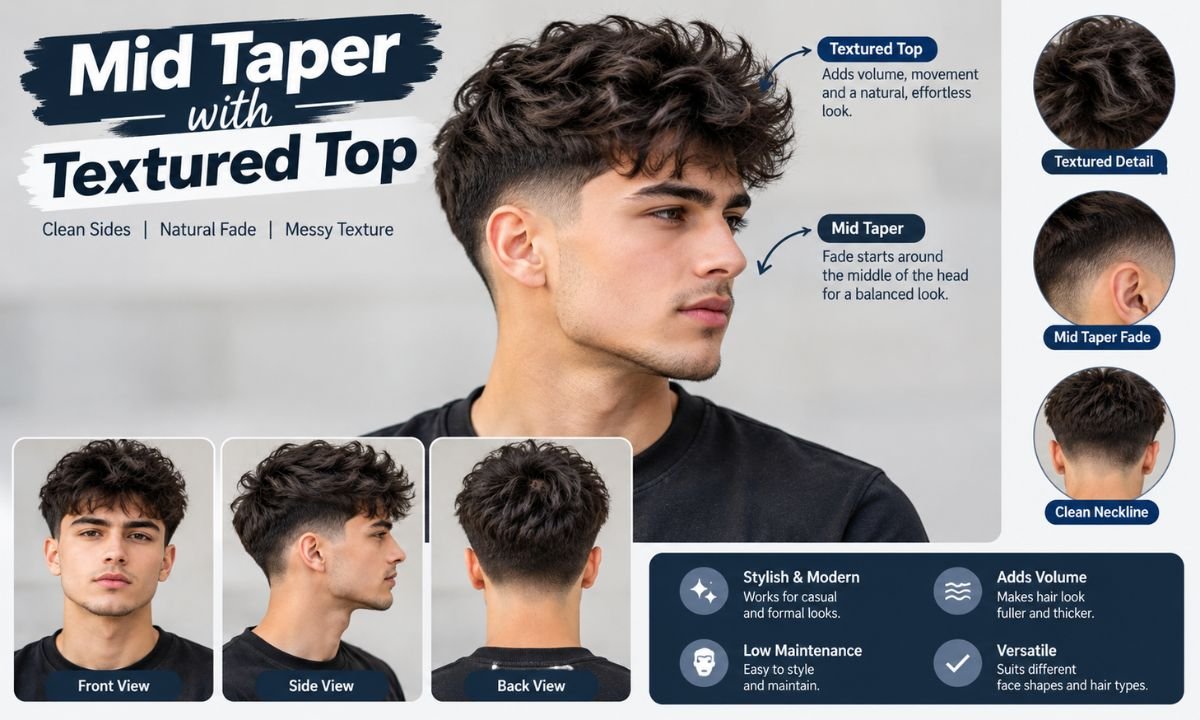
Want something a little more flexible? A mid taper with textured top lets you change the front without changing the sides. You can wear the top as a textured crop fade, a forward fringe haircut, or a swept-up quiff.
The textured crop with mid taper keeps things short and clean. It uses a shorter fringe with a blunt horizontal edge that gets broken up by point cutting. You get structure without looking stiff.
A slightly longer top moves toward a classic mid taper fringe hairstyle. Here the hair sweeps across the forehead and the ends stay loose. This version looks relaxed and works for most hair types.
Try the shadow mid taper if you like a softer fade. It leaves a light shadow of hair instead of cutting down to skin, so the transition looks almost airbrushed. It’s a favorite for guys who want polish without a high-contrast edge.
Textured Fringe vs French Crop

These two cousins confuse many people. Both have short sides and a longer top. The difference sits in the front edge.
A French crop usually has a straight, cropped fringe that sits high on the forehead. A textured fringe is longer, softer, and more broken. So when people ask about French crop vs textured fringe, think crisp line versus feathered line.
| Feature | French crop | Textured fringe |
| Front edge | Straight, short | Broken, longer |
| Length | 1 to 2 inches | 2 to 4 inches |
| Styling | Minimal | Moderate |
| Best for | Receding hairlines | Most hair types |
If your hairline is thinning at the temples, the French crop hides it well. If you want more movement and a youthful feel, choose the fringe. Both pair nicely with a mid taper.
Who Suits This Haircut?
Good news: almost everyone can wear it. The cut adapts to face shape, hair type, and age. You just tweak length and texture.
Round faces benefit from extra height on top. Add root lift and keep the fringe slightly shorter to create vertical lines. A tighter taper also makes the face look longer.
Square and oval faces can handle a longer fringe with more forward movement. Long faces do best with a fuller fringe that covers part of the forehead. That shortens the look and adds balance.
What about beards? A tapered sideburn blends smoothly into a short beard, so the whole look stays connected. Ask your barber to match the beard fade to the taper height for a seamless finish.
Maintenance and the Blunt-Line Problem
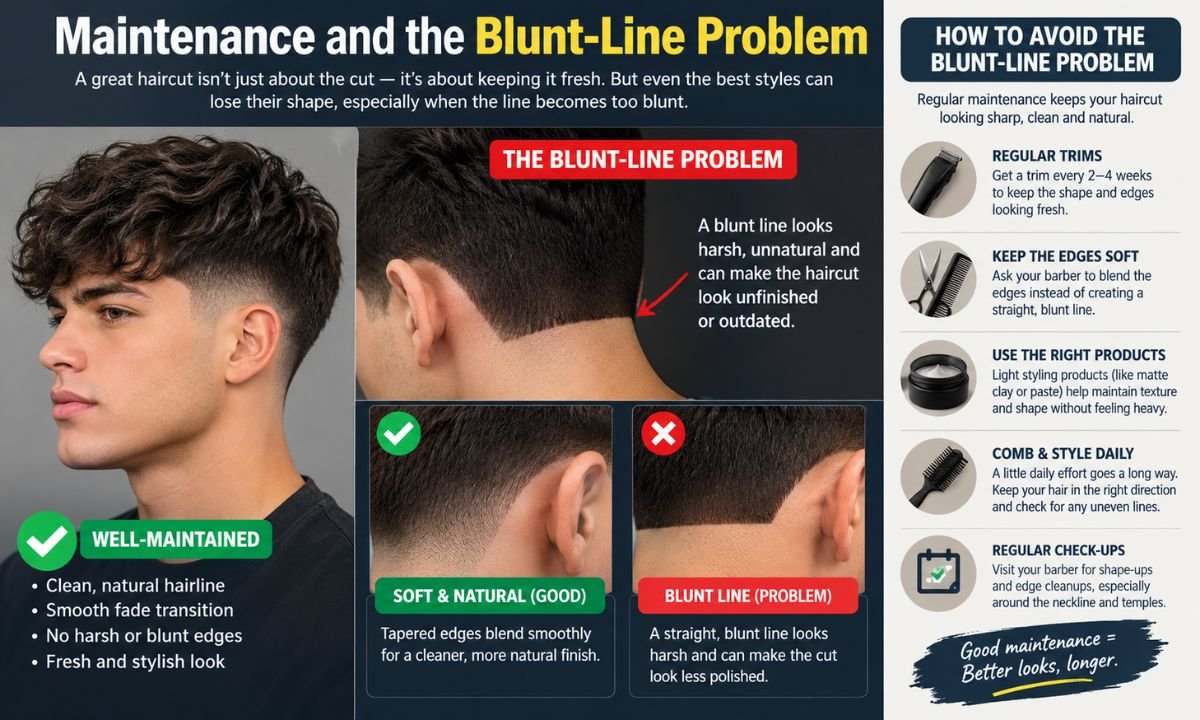
Here’s the truth no one tells you. A great cut looks great for about two weeks. After that, upkeep decides everything.
How often to trim a mid taper fade? Plan on every four to five weeks. The taper loses its shape as the sides grow in, and the neckline goes fuzzy first. A quick taper refresh keeps things sharp.
The fringe needs less frequent attention. Trim it every six to eight weeks to keep the ends choppy and the fringe length under control. Between visits, you can tidy the neckline at home if your barber shows you how.
How to avoid a blunt fringe haircut
A blunt fringe happens when the barber cuts straight across with no breaks. It looks heavy and flat, and that’s how many men end up with a bowl cut. Prevention starts with clear instructions.
Ask for point cutting and separated ends, then watch for a hard blunt horizontal edge. If you see a straight line forming, politely ask your barber to break it up. Most are happy to adjust.
At home, fix a heavy front by twisting small sections between your fingers with clay. That recreates fringe separation within seconds. Also push the fringe slightly to the side instead of straight down.
How to stop a textured fringe looking like a bowl cut
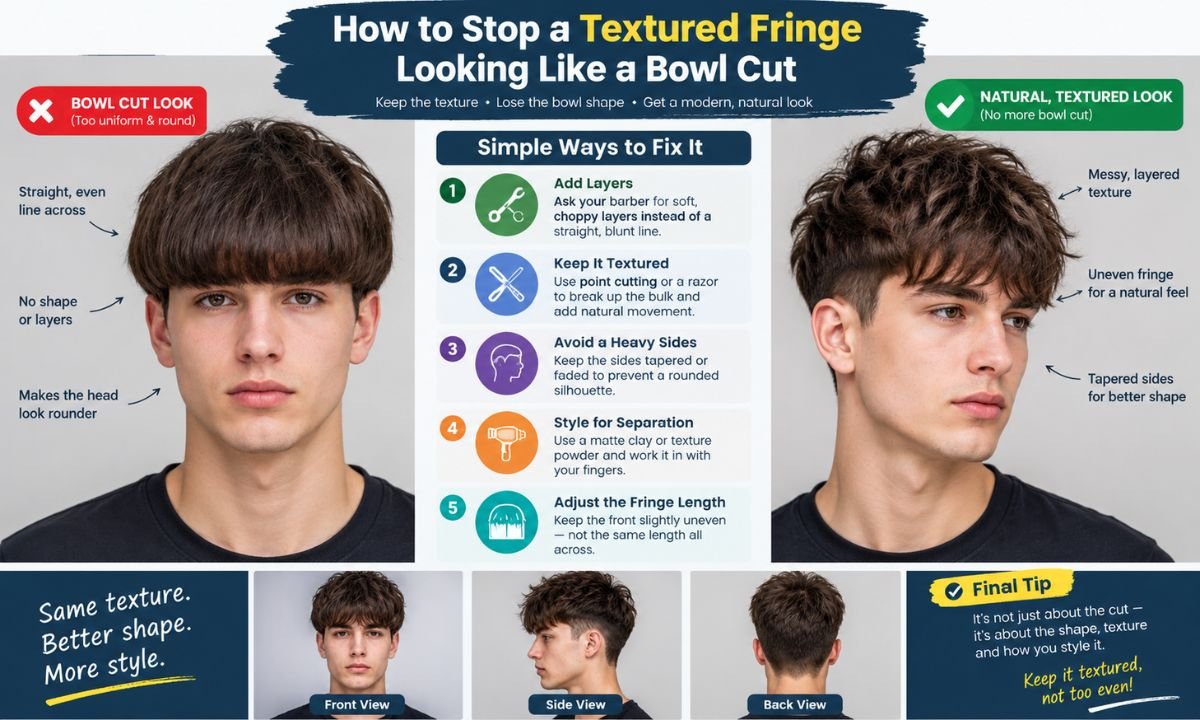
A bowl cut has two ingredients: uniform length and a flat edge all the way around. Your haircut avoids both because the taper removes weight from the sides. Keeping the upper sides short enough to blend, but not boxy, matters a lot.
Style forward and slightly up, not straight down. Root lift adds height, which breaks the bowl silhouette immediately. A matte finish also helps, since shiny hair tends to clump into a helmet.
How to maintain a textured fringe as it grows
During hair growth, the fringe gets heavy and starts to poke into your eyes. Ask for a light trim that keeps preserving top length while removing damaged tips. Avoid over-thinning, because that creates weak, see-through ends.
When the fringe gets long, switch to a side-swept style for a few weeks. Add texture powder to keep it from drooping. It’s a handy trick while you wait for your next appointment.
How to keep the upper sides fuller with a mid taper
Tell your barber to start the taper lower than the temple on the upper sides. Ask them to use scissors over comb instead of clippers there. That leaves hair weight in place and keeps the shape rounded.
A fuller side also helps if you’ve got a narrow head or a long face. It adds width where you need it. Just don’t let it grow too long, or the cut loses its clean outline.
Professional Styling Reference
You don’t need a bathroom full of bottles. A few well-chosen products handle nearly every situation. Here’s a quick reference that mirrors what stylists reach for.
| Product | Best for | Finish | Tip |
| Matte clay | Thick, coarse hair | Strong hold, no shine | Warm it up first |
| Matte paste | Wavy or medium hair | Flexible, natural | Use on damp or dry hair |
| Texture powder | Fine, flat hair | Light grip, volume | Sprinkle at the roots |
| Texture foam | All types | Soft body | Apply to damp hair |
| Pre-styler | Fine or limp hair | Base lift | Spray before blow-drying |
Wondering about the best matte clay for a textured fringe? Pick one with strong hold and a water-based formula, since it rinses out easily. Test a small tub first, because every scalp reacts differently.
Want to know how to style a fringe without making it greasy? Start with clean, dry hair and use a tiny amount. Distribute it with your fingers, not a comb. Greasy hair usually means too much product or a heavy wax.
For how to create separation in a textured fringe, rub clay in your palms and pinch the tips. Twist small pieces and release. That gives you a piecey finish that looks deliberate but relaxed.
If your hair is hard to control, consider a professional styling session. A barber can show you your exact blow-dry angle and product amount. One lesson often saves months of trial and error.
Common Mistakes to Avoid
Even a good haircut can go sideways. Most problems come from a few repeat offenders. Spot them early and you’ll save yourself plenty of frustration.
- Too much product. It weighs hair down and kills texture.
- Styling wet hair with clay. Clay needs dry or barely damp hair to grip.
- Cutting wet only. Always check dry hair length before leaving.
- Over-thinning. It removes internal bulk and leaves frizzy ends.
- Skipping upkeep. A tired neckline ruins an otherwise good cut.
Another slip is ignoring your hair growth direction. Cowlicks fight the forward fringe, so adapt the cut to the way your hair wants to move. Your barber should spot this in minutes.
And please, don’t copy a photo without checking your hair type. A style that works on thick hair might look sad on fine strands. Choose references that match your hair texture and hair density.
Frequently Asked Questions
How do I get a mid taper fade with textured fringe?
Book with a barber who shows similar work in their portfolio. Ask for a mid taper at the temple, fuller upper sides, and a textured fringe about 3 inches long. Bring photos from the front, side, and back.
What’s the best mid taper fade with textured fringe for men?
The best version suits your hair texture and lifestyle. Straight hair likes a shorter crop, wavy hair likes extra length, and thick hair needs smart thinning. Pick the one that fits your daily routine.
How long should a textured fringe be?
Most men do well with 2 to 4 inches of dry length. It should reach the middle of your forehead without poking your eyes. Adjust slightly for waves and fine hair.
Is a mid taper the same as a mid fade?
No. A mid taper is a subtle, localized shortening around the ears and neckline. A mid fade removes much more hair from the sides and looks bolder.
How often should I trim it?
Visit your barber every four to five weeks for the taper. Trim the fringe every six to eight weeks. A quick neckline cleanup between visits helps.
Can I wear it with thick hair?
Yes, with careful bulk removal. Ask for inside thinning, not chopped ends. Use matte clay to control the heavier strands.
Will it work on wavy hair?
Absolutely. Waves create natural fringe separation, so styling gets easier. Keep a bit more length and use frizz control products.
How do I stop it looking like a bowl cut?
Ask for point cutting and a taper that removes weight from the sides. Style the fringe forward and up with root lift. Avoid a straight, blunt edge.
Which product should I use?
Matte clay suits thick hair and strong hold. Matte paste works for wavy or medium hair. Texture powder helps fine hair gain volume.
Is it still trendy in 2026?
Yes. The look has settled into a reliable classic because it’s flexible and easy to wear. It’s a safe pick whether you’re 18 or 48.
Final Thoughts
A mid taper fade with textured fringe earns its popularity. It looks sharp, feels relaxed, and adapts to nearly every hair type. Once you learn the right words and the three-step routine, it takes almost no effort.
Remember the big ideas. Keep the taper soft, the fringe broken, and the upper sides fuller. Check your dry hair length, and trim on schedule.
Now it’s your turn. Which version are you leaning toward: the textured crop, the longer forward fringe, or the shadow mid taper? Drop a comment, share this guide with a friend who needs a haircut, and tell us how your next visit goes.
